Σάββατο 21 Απριλίου 2012

Saint Bathilde, Queen of France († 680)


St. Batilda. Other forms of her name are Bathilidis, Bathild, Bathchilde, and Bauteur.
An Anglo-Saxon by birth, St. Batilda was captured in 641 by Danish raiders and sold to Erchinoald, the chief officer of the palace of Clovis II, King of the Franks. She quickly gained favour, for she had charm, beauty, and a graceful and gentle nature. She also won the affection of her fellow-servants, for she would do them many kindnesses such as cleaning their shoes and mending their clothes, and her bright and attractive disposition endeared her to them all.

The officer, impressed by her fine qualities, wished to make her his wife, but Batilda, alarmed at the prospect, both by reason of her modesty and of her humble status, disguised herself in old and ragged clothes, and hid herself away among the lower servants of the palace; and he, not finding her in her usual place, and thinking she had fled, married another woman.

Her next suitor, however, was none other than the king himself, for when she had discarded her old clothes and appeared again in her place, he noticed her grace and beauty, and declared his love for her. Thus in 649, the 19-year-old slave girl Batilda became Queen of France, amidst the applause of the court and the kingdom. She bore Clovis three sons: Clotaire III, Childeric II, and Theodoric III--all of whom became kings. On the death of Clovis (c. 655-657), she was appointed regent in the name of her eldest son, who was only five, and ruled capably for eight years with Saint Eligius (f.d. December 1) as her advisor.

She made a good queen and ruled wisely. Unlike many who rise suddenly to high place and fortune, she never forgot that she had been a slave, and did all within her power to relieve those in captivity. We are told that "Queen Batilda was the holiest and most devout of women; her pious munificence knew no bounds; remembering her own bondage, she set apart vast sums for the redemption of captives." She helped promote Christianity by seconding the zeal of Saint Owen (f.d. August 24), Saint Leodegar (f.d. October 2), and many other bishops.

At that time the poorer inhabitants of France were often obliged to sell their children as slaves to meet the crushing taxes imposed upon them. Batilda reduced this taxation, forbade the purchase of Christian slaves and the sale of French subjects, and declared that any slave who set foot in France would from that moment be free. Thus, this enlightened women earned the love of her people and was a pioneer in the abolition of slavery.

She also founded many abbeys, such as Corbie, Saint-Denis, and Chelles, which became civilised settlements in wild and remote areas inhabited only by prowling wolves and other wild beasts. Under her guidance forests and waste land were reclaimed, cornland and pasture took their place, and agriculture flourished. She built hospitals and sold her jewellery to supply the needy. Finally, when Clotaire came of age, she retired to her own royal abbey of Chelles, near Paris, where she served the other nuns with humility and obeyed the abbess like the least of the sisters.

She died at Chelles before she had reached her 50th birthday. Death touched her with a gentle hand; as she died, she said she saw a ladder reaching from the altar to heaven, and up this she climbed in the company of angels.

She is the patroness of children. Holy Mother Batilda, pray to God for us!


Τρίτη 10 Απριλίου 2012

Saint Rupert (Robert) of Salzburg, Apostle to Bavaria and Austria


March 27th is the feast of St Rupert, a most holy and blessed man. This feast commemorates the day of his repose, which brings spiritual joy to devout minds and refreshes hearts throughout the entire year. As the Scriptures say, "The righteous shall be in everlasting remembrance." He who passes into the angels' joy is made worthy of men's remembrance: as the Scriptures say, "A wise son is the glory of the father," and how great is his glory, who redeemed so many barbarian nations through the knowledge of God in Christ Jesus through the Gospel!
When Childebert the king of the Franks was in the second year of his reign, the Bishop of Worms was the Holy Confessor Rupert, who was born into the ranks of the Frankish nobility, but was far more noble in faith and piety. He was gentle and chaste, simple and prudent, devout in praise of God, full of the Holy Spirit. He was also circumspect in his decisions and righteous in his judgment. He possessed great spiritual discernment, and his good deeds formed his flock into true images of Christ, for he inspired them not only with his words, but by the example of his works. He often kept vigil, weakened himself with fasting, and adorned his works with compassion. He gave away his riches that the poor might not go hungry, believing himself to be one who should clothe the naked and help the destitute.
When the great fame of this most venerable man had spread to the ends of the world, powerful men, not only in that region but from other nations, poured in to hear his most holy teaching. Some with many sorrows came to receive consolation through his holy words, and other churchmen came to learn the purity of true Orthodoxy from him. Many were freed from the snares of the ancient enemy by his loving spiritual advice, and were able to set out on the path to salvation. But unbelievers, who were numerous in the vicinity of Worms, not understanding his holiness, exiled him from the city in a most shameful manner. They caused him terrible suffering and beat him with rods. At that time Theodo, the Duke of Bavaria, hearing about the miracles which this most holy man had performed and of his blessedness, desired to meet him. With firm resolve he dispatched his most trusted men to summon him to his court and to enquire of him how long might he consent to visit the regions of Bavaria, and could he instruct him in the way of life-giving faith? The blessed bishop, having received such a sincere and heartfelt request knew that it came from Divine dispensation and thanked the Merciful One, because "those who sat in the darkness and the shadow of death" longed to know the author of life, Jesus Christ.
As a result of this he sent his own priests, as if they were rays of faith, to return with the ambassadors of the Duke, and he himself after a short time undertook the journey to Bavaria. When the Duke heard the news that the blessed one was on his way he was overcome with great joy, and he and a large retinue hastened to meet St Rupert, overtaking the saint in the city of Regensburg. Although exhausted and hungry from his long journey, St Rupert, right away began to reveal to the Duke the mystery of the heavens and instructed him in the Orthodox faith. He convinced the Duke to renounce the worship of idols, and baptized him in the name of the Holy and Indivisible Trinity. The nobles and the simple people were also baptized with the noble duke, praising Jesus Christ the Saviour of the world, who considered them worthy to be called wondrously into His light from their darkness through His confessor, the most blessed Rupert. By his holy words their darkened hearts were enlightened and the souls of the unbaptized thirsted for the fountain of life.
When the saint had revealed Divine Truth by having baptized the Duke and his people, Theodo came to understand the mystery of saving baptism. He begged the holy Rupert to carry the light of Orthodoxy to others and the saint, fulfilling his desire, boarded a ship and sailed down the River Danube. Through the towns, villas, and forts, he declared the gospel of Christ in a great voice. To the ends of Noricum, into the lower parts of Pannonia, he brought the light of the teachings of Christ which illumines all. Having returned by land, he entered Lauriacum (torch on the River Enns), in whose water he baptized many, freeing them from the worship of idols. In the name of Jesus Christ he healed many who had been oppressed by various illnesses and passions. After he left Lauriacum he saw the spiritual darkness of the tribes in that region; he boldly undertook to smash images and to proclaim everywhere the divinity of the Lord Jesus Christ as well as His most holy incarnation. He brought them to believe that He truly is both God and man, truly begotten of the Father before all ages. He taught them that Christ is the Word of God conceived by the Holy Spirit and born of the Virgin Mary for the salvation of mankind.
Having accepted the episcopacy after being entreated to do so by the Duke and his people, he went to the placid waters of Lake Wallersee, where a church had been built in honour of the chief apostle Peter. He moved from there to the Juvavian (Salzach) River, the site of the city of Juvavia, which had been erected in ancient, tumultuous times. At one time it had had great importance among Bavarian cities, but by the time St Rupert arrived it had become overgrown with trees and weeds and only a few people lived among the ruins. The servant of God considered this a suitable place for his episcopal cathedral, because being situated high in the mountains, it was far from the tumult and distractions of crowds. He went before the duke, and spoke to him with great enthusiasm about his plan to build a basilica there in honour of the blessed Peter, Chief of the Apostles. He was granted the vast sums needed to build the splendid church by the generosity of Theodo. When the church was finished he ordained priests, and commanded them to celebrate the daily offices in canonical order. The saint of God then wished to enlarge his holdings in the vicinity of the cathedral, so he petitioned the Duke for yet another donation, and with the funds donated to him he purchased the estate known as Piding for thousands of solidi, a great sum of money at the time. Thus, by the will of God and the bequests of kings, noblemen, and the faithful, the centre of spiritual life for the kingdom began to grow.
Here is an account of a wondrous event in the life of St Rupert. Some very reliable men came to the blessed hierarch and told him of an amazing phenomenon which had taken place when they had gone into an unnamed wilderness area now called Bongotobum (Pongau). Three or four times they had seen heavenly lights shining like bright lamps in the sky and they had also experienced a wonderful fragrance in the same place. The pious bishop sent the priest Domingus to Bongotobum because of the reports which he received concerning these lights. It was his desire that the priest would verify the authenticity of these wonders by erecting in that location a wooden cross which the holy one had made and blessed with his own hands. When Domingus arrived, he at once began the First Hour with the monks who had come with him. They saw a bright heavenly light which descended from the sky and lit up the entire region with the brightness of the sun. Domingus saw this vision on three nights in a row, and experienced the wondrous fragrance as well. He erected the blessed cross in that place, and it was miraculously transported to a spot above the dwelling of St Rupert, confirming the truthfulness of what had been reported to him! St Rupert took word of the miraculous occurrence to Theodo and then he himself went into the wilderness to the very spot, and seeing that it was suitable for habitation, began to cut down aged oaks and brought in building materials that he might build a church with dwellings for a monastic community..
At about the same time, Theodo fell into ill health, and felt the end of his life approaching. He called to his bedside his son Theodobert, appointing him the Duke of Noricum, admonishing him to be obedient to St Rupert and to aid him in his holy work as well as to firmly establish and support the Juvavian church with love, honour, and dignity. He also adjured him to protect and exalt it. When he had instructed his son in all good things and had given him his final testament, he ended his earthly life and fell asleep in the Lord. After the repose of his God-fearing father, Duke Theodobert along with his nobles remained followers of St Rupert because of his great sanctity. Having travelled to see the saint in his far hermitage, the duke honoured him with pious affection and went to pray in the church which the saint had built there. The duke donated three parcels of land in honour of St Maximilian and gave property on all sides of the forest, as well as an estate in the Alps. He gave gifts to support the monastery and the hieromonks whom the most blessed Rupert had ordained for the Service of God.
When this had been accomplished, the man of God saw that the most noble man of Bavaria had submitted himself to the yoke of Christ and had left worldly concerns to the lesser men of his kingdom. St Rupert then accompanied the duke back to his homeland and then returned with twelve of his closest spiritual children (among whom were Kuniald and St Gisilarius, both priests and both holy men). His niece, St Ermentrude, a virgin dedicated to Christ also accompanied them to the city of Juvavia. There in the main fortress of the city he built a monastery in honour of Our Lord Jesus Christ the Saviour and His Most Pure Mother, the Ever-Virgin Mary. He placed as abbess in that monastery St Ermentrude, that she might serve the King of Heaven. With the generous support of Duke Theodobert, who gave many gifts to the nuns, he established a monastery which had all its spiritual and physical needs well taken care of.
When all this had been accomplished, the blessed man became eager to complete the missionary efforts he had begun with the help of Christ. Accompanied by clergy and monastics, he resolved to visit his followers in the Norican kingdom. Having left the city of Juvavia he visited people on whom the light of faith had not yet shown, and he sowed the wheat of faith amid tares. The deception of the devil fled from the hearts of these barbarian tribes, and Rupert sowed in its place faith, love, mercy, and humility, for through these Christ, the giver and source of all good, is able to take up residence in the human heart. He travelled to all the ends of Bavaria, and converted the people to faith in Christ, and strengthened those who had remained steadily faithful. Having sent out several priests and men of God who brought the Divine Mysteries to the people, he became anxious to return to Juvavia. Because he had the gift from God of knowing the future, he knew that the day of his repose was at hand. He revealed this to his disciples, who were filled with sorrow and anguish. Because of this, there was much weeping and great mourning when he took leave of his newly enlightened Christian flock.
Filled with certainty and faith in Christ, St Rupert commended the city, the Norican people, and all who had been received into holy Orthodoxy to the Most High and All-Knowing God. He chose Vitale, a holy man whom the people themselves had accepted, as his successor. When the forty days of Great Lent had passed, Bishop Rupert became very ill and was exhausted by a high fever. When the most holy day of the Resurrection of Our Saviour Jesus dawned, he celebrated the solemn Liturgy, and was fortified for his final journey with the precious Body and Blood of Christ. He comforted his priests, monastics and flock with a beautiful sermon filled with much love. Then, surrounded by his weeping spiritual children he breathed his last and returned his most pure soul to God. A host of angels were sent by Christ and the saints in the heavens who bore his holy soul with melodious voices to eternal happiness. Thus the faithful servant of God rested in peace. He whose life was praiseworthy and blameless was in death equally blessed. Thus it is written: "Precious in the sight of the Lord is the death of His saints." Shortly after his repose many miracles were attributed to him, for God was gracious through the relics of His saint and manifested His tender mercy. By the prayers of the friend of God, St Rupert, the faithful were comforted and the Church adorned through innumerable miracles. Indeed the Blessed God, One in three Persons, lives and reigns; to Him be all praise and glory unto the ages of ages. Amen

Κυριακή 8 Απριλίου 2012

Saint Ansgar (Anskar, Anschar, Anscharius, Scharies) of Germany and Evangelist of Scandinavian lands († 865)


Born near Amiens, Picardy, France in 801, died in Bremen, Germany on February 3, 865.
With the coming of the barbarians after the death of Charlemagne, darkness fell upon Europe. From the forests and the fjords of the north, defying storm and danger, came a horde of pirate invaders, prowling round the undefended coasts, sweeping up the broad estuaries, and spreading havoc and fear. No town, however fair, no church, however sacred, and no community, however strong, was immune from their fury. Like a river of death the Vikings poured across Europe.
It's hard to believe that there would be an outbreak of missionary activity at such a time, but in Europe's darkest hour there were those who never faltered, and who set out to convert the pagan invader. St.Ansgar was such a man. As a young boy of a noble family he was received at Corbie monastery in Picardy and educated under Saint Abelard and Paschasius Radbert. Once professed, he was transferred to New Corbie at Westphalia. He once said to a friend, " One miracle I would, if worthy, ask the Lord to grant me, and that is, that by his grace, he would make me a good man."
In France a call was made for a priest to go as a missionary to the Danes, and Ansgar, a young monk, volunteered. His friends tried to dissuade him, so dangerous was the mission. Nevertheless, when King Harold, who had become a Christian during his exile, returned to Denmark, Ansgar and another monk accompanied him. Equipped with tents and books, these two monks set out in 826 and founded a school in Denmark. Here Ansgar's companion died, and Ansgar was obliged to move on to Sweden alone when his success in missionary work led King Bjørn to invite him to Sweden.
On the way his boat was attacked by pirates and he lost all his possessions, arriving destitute at a small Swedish village. After this unpromising start, he succeeded forming the nucleus of a church -- the first Christian church in Sweden -- and penetrated inland, confronting the heathen in their strongholds and converting the pagan chiefs.
Ansgar became the first archbishop of Hamburg, Germany and abbot of New Corbie in Westphalia c. 831. The Pope Gregory IV appointed him legate to the Scandinavian countries and confides the Scandinavian souls to his care. He evangelized there for the next 14 years, building churches in Norway, Denmark and northern Germany.
He saw his accomplishments obliterated when pagan Vikings invaded in 845, overran Scandinavia, and destroyed Hamburg. Thereafter the natives reverted to paganism. Ansgar was then appointed archbishop of Bremen around 848, but he was unable to establish himself there for a time and Pope Nicholas 1 united that See with Hamburg. Nicholas also gave him jurisdiction over Denmark, Norway, and Sweden.
Ansgar returned to Denmark and Sweden in 854 to resume spreading the Gospel. When he returned to Denmark he saw the church and school he had built there, destroyed before his eyes by an invading army.
His heart almost broke as he saw his work reduced to ashes" The Lord gave," he said, "and the Lord have taken away. Blessed be the name of the Lord." With a handful of followers he wandered through his ruined diocese, but it was a grim and weary time. "Be assured my dear brother, " said the primate of France, who had commissioned him to this task, "that what we have striven to accomplish for the glory of Christ will yet, by God's help, bring forth fruit."
Heartened by these words, and with unfailing courage, Ansgar pursued his Swedish mission. Though he had but four churches left and could find no one willing to go in his place, he established new outposts and consolidated his work.
King Olaf had cast a die to decide whether to allow entrance of Christians, an action that Ansgar mourned as callous and unbefitting. He was encouraged, however, by a council of chiefs at which an aged man spoke in his defense. "Those who bring to us this new faith," he said" by their voyage here have been exposed to many dangers. We see our own deities failing us. Why reject a religion thus brought to our very doors? Why not permit the servants of God to remain among us? Listen to my council and reject not what is plainly for our advantage."
As a result, Ansgar was free to preach the Christian faith, and though he met with many setbacks, he continued his work until he died at the age of 64 and was buried at Bremen. He was a great missionary, an indefatigable, outstanding preacher, renowned for his austerity, holiness of life, and charity to the poor. He built schools and was a great liberator of slaves captured by the Vikings. He converted King Erik of Jutland and was called the "Apostle of the North", yet Sweden reverted completely to paganism shortly after Ansgar's death.
Ansgar often wore a hair shirt, lived on bread and water when his health permitted it, and added short personal prayers to each Psalm in his Psalter, thus contributing to a form of devotion that soon became widespread.
Miracles were said to have been worked by him. After Ansgar's death, the work he had begun came to a stop and the area reverted to paganism. Christianity did not begin to make headway in Scandinavia until two centuries later with the work of Saint Sigfried and others. A life story was written about Ansgar by his fellow missionary in Scandinavia, Saint Rembert (Attwater, Attwater2, Benedictines, Bentley, Coulson, Delaney, Encyclopedia, Fanner, Gill, Robinson, White)
In art Ansgar is shown with converted Danes with him (White), wearing a fur pelisse (Roeder). He may sometimes be shown otherwise in a boat with King Harold and companions or in a cape and miter Hamburg Cathedral (Roeder).

Saint Ansgar is the patron of Denmark, Germany and Iceland (White). He is venerated in Old Corbie (Picardy) and New Corbie (Saxony) as well as in Scandinavia (Roeder).

Τετάρτη 4 Απριλίου 2012

Saint Severinus, Apostle of Austria († 482)


St. Severinus came to the borderland of present-day Germany and Austria from the east — possibly the Egyptian desert — to care for the Roman Christians who were endangered by invading barbarians during the collapse of the Roman Empire.
He remained there until the end of his life. While he was there he advised both common people and kings to put eternal life first, and taught them to be generous to one another and to lead a true Christian life.
He built a monastery and protected from harm those who gathered around him. As he foretold, the monks and other Christians who had followed him escaped to saftety in Italy, taking St. Severinus' incorrupt relics with them.
 His relics are still honored in Frattamaggiore, Italy (near Naples).

 —from the 2006 Saint Herman Calendar

Source: http://www.abbamoses.com/months/january.html
 

The Orthodox Saints of France


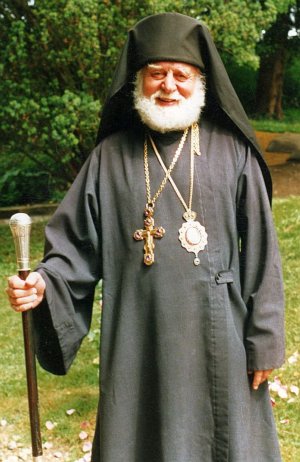
Archbishop Seraphim (Igor Aleksandrovich Dulgov) was born in 1923 in Moscow. In 1928 he left with his mother, first to Berlin and later to France. He received his primary education in a Russian school and in the Cadet Corps in the suburbs of Paris, where he had the obedience of serving in the altar and as a reader. During World War II, he studied at a French engineering school. After the war he graduated from the St. Serge Orthodox Theological Institute in Paris (1946-1950). He then worked at a factory in Versailles. He served as a sub-deacon to Bishop (later Archbishop) Nathanael (Lvov). In 1961 he was ordained a deacon and priest in Geneva, and then served at the Church of the Archangel Michael in Cannes. In 1971 he became an archpriest and dean of southern France, and later the rector of the St. Nicholas Church in Lyons. He had the intention of retiring to a skete of the Lesna Convent in France. In September 1993 he was tonsured a monk with the name of Seraphim. He was consecrated as Bishop of Lesna on September 19, 1993, in Geneva and became vicar of the Western European Diocese. On November 3, 1993, he became the ruling bishop of the Western European Diocese with the title of Bishop of Lesna and Western Europe; in 1995 he was named Archbishop of Brussels and Western Europe. After his retirement he settled in the Lesna Convent in France, and there departed in Christ on November 24, 2003.

How to Identify Whether a Saint is Orthodox or Catholic

The question of the Orthodox saints of France can be an historical one – one is interested in learning the history – or it can be a matter of curiosity, veneration, or a topic for pious reading.
For us, in addition to all of the above, there is also a practical issue. Why? For instance, when a Frenchman or a Swiss converts to Orthodoxy, what name should he take? We have a priest named Fr. Quentin. But name me a single Russian priest in pre-revolutionary Russia who would have known that there was such a name! Yet St. Quentin is a perfectly Orthodox saint of Western Europe. A priest will fly from South America to London to venerate the relics of St. Edward (and I am sure that when our priests see for “the health” or “the repose of” an Edward they would pass it off as non-Orthodox). But it turns out that Edward is a perfectly Orthodox name. And there are many such examples.
For example, when someone becomes Orthodox, what name should he take? He may, of course, retain his name if there is such a saint, such as the name John (there are St. John Chrysostom, St. John of Kronstadt, St. John the Damascene, St. John the Baptist), or he may intentionally take a new name. We had one boy named Charles. There is no saint named Charles. So when he became Orthodox, he was given the name of the Hieromartyr Harlampus (Charles and Harlampus are consonant in French).
I told you yesterday about our pilgrimages, when we searched for Orthodox saints in one location or another in France, read their lives, and sometimes painted their icons. You may ask: how can we determine who is an Orthodox saint and who is not? I implore you never to think of 1054 as some milestone, that one day prior to 1054 it was exactly one way, and the day after it was different. Rather, this was a lengthy process that began in the seventh century and ended with the seizure of Constantinople by the Crusaders in the thirteenth century.
The year 1054 was pulled out of history by the Latin Cardinal Baronius, who wanted to determine the exact moment when we were still Catholic (in his understanding) and then at what moment we ceased to be Catholic. Therefore, when we celebrated the millenium of Christianity in Russia, many Catholics approached me in Lyon and said: “Turns out you were Baptized by Catholics, since it happened before 1054!”
According to Bishop Nathaniel, when defining who is an Orthodox saint and who is not, we need first of all to understand that a holy saint of God has no not need of our glorification; he is glorified by the Lord, and whether or not he enters our church calendar is of no significance to him. Yet we ourselves need to know whose example we should or should not follow. Thus we believe all Western pre-seventh century saints to be Orthodox, but after the eighth century we should seriously study their influences. For example, if the saint lived here in northern France, then he was influenced by England, which remained Orthodox longer than any other Western European country. But if he lived nearer to Germany, then there were early heretical currents in that area. Do not forget that two centuries before 1054 the Creed had already been changed in the West! So Western saints from the ninth century on are, of course, venerable people, but not Orthodox saints. However, Bishop Nathaniel notes two or three cases of Orthodox saints in Bohemia even after 1054.

The Origins of Christianity in France

When our Lord Jesus Christ ascended, He instructed the Apostles to preach the Gospel to all creation. Their preaching, which began in Jerusalem and Rome and, according to the Apostle Paul, continued to Corinth and Ephesus, then spread even further. You know that the Apostle Paul made several missionary journeys. The Lord came at the right historical moment, for Christianity could spread rapidly by the roads of the Roman Empire, despite persecution. Although we are unaware of apostolic preaching in France,* the country quickly developed spiritually, and became famous for its outstanding preachers and martyrs.
Martyrs are the blood of the Church; martyrs are the Church’s foundation. From this we see that the Christian message resonated with the Gallo-Romans. Tertullian, an ecclesiastical writer of the second century, wrote: “we were born only yesterday, but we have completely covered the Earth.” Two centuries later the Blessed Augustine echoes him: “the greatest miracle is that yesterday we were nothing, yet now we entirely cover the universe.” Of course, the “universe” in their understanding was the Roman Empire.

Lyon


Lyon
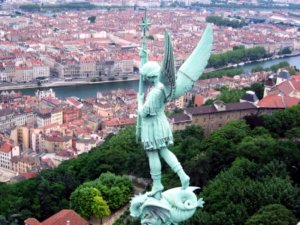
Lyon is the ancient center of France, called Lugdunum in the Roman Empire. Christianity came to Lyon not from the Apostles, but from the Orthodox East (from which St. Pothinus came, while St. Irenaeus of Lyon was a disciple of St. Polycarp, who was a disciple of St. John the Evangelist). In 177, there were already many Christians in Lyon who were being persecuted (note that we Russians became Christian only in the ninth century!). Letters from Christians have been preserved from that time, and they describe the terrible persecutions that suddenly began on Holy Friday. A statue of a pagan goddess was erected and Christians were compelled to venerate it with everyone else (refusal meant being guilty of treason against Caesar). The Christians refused. At first, the weakest (children, girls, women) were taken in hope that they would not endure trial. On the contrary, the women and children were the most zealous. Then servants were bribed. They betrayed their Christian masters, saying that they “drink blood, do all sorts of other horrible things and, most significantly, do not worship Caesar.” Following their testimony, thirty-five to forty people were thrown into prison. Among them were the maiden Blandina, the boy Ponticus, and the ninety-year-old Bishop Pothinus (who died of starvation in prison). Those who survived were thrown to wild beasts in the amphitheater. Blandina was first tied to a post in the Lyon arena – yet when the raging lions came, they lay down at her feet. Recall St. Gerasimus of the Jordan! From the lives of the saints we know that wild animals do not touch God’s saints. But then she was bound in a net and thrown on the horns of an angry bull, which trampled her death.

The Suffering of the Martyr Blandina
We know the names of the martyrs from the first persecution, and the priest at our church in Lyon commemorates them during Proskomedia. When the amphitheater was excavated, the first divine service (amazing but true!) was served by the Orthodox in Lyon – although because of this the archaeologist, I believe, later got into trouble with the Catholics but, nevertheless, the first service was ours.

The Lyon Arena
After the persecution of 177 came the persecution of 178, and then the third persecution, in 203. In that year, 19,000 Christians suffered martyrdom, including Bishop Irenaeus of Lyon. This demonstrates that by the beginning of the third century Lyon was already a completely Christian city. Saint Ireaneus wrote against the heresies. Yet it just so happened that the penultimate Roman Catholic Cardinal of Lyon built an ecumenical center there – so, in other words, a heresy center was built exactly on the spot where St. Irenaeus had once written a book against the heresies! Following the third persecution Lyon emptied.
So, when a Frenchman becomes Orthodox (I am referring to France, but this is also applicable to Germany and Switzerland), we should not say that he changed his faith, but rather that he returned to the original faith that once predominated in his land. We must revere the saints of the first centuries as our own. Those saints are our saints.


Marseilles

Marseilles

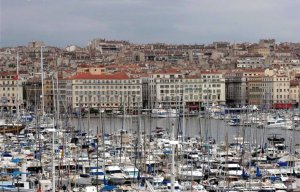
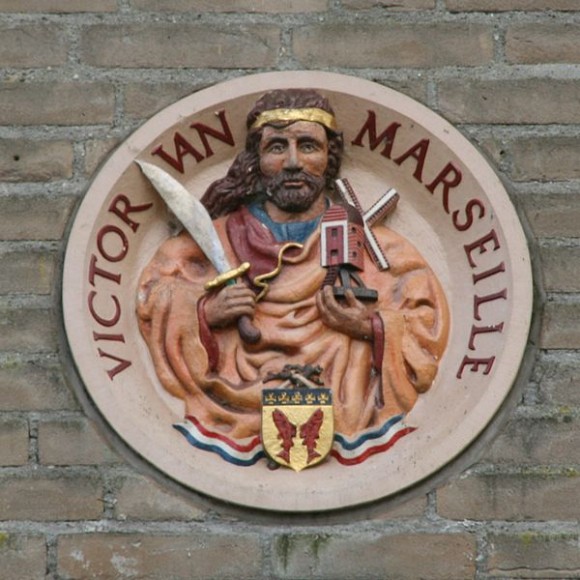
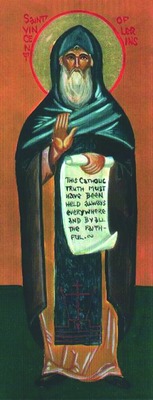
In Marseille there are also many saints. Cannes is located across from the island of St. Honorat, where the first monks lived that came from the East in the fourth and fifth centuries. Among them, I especially want to remind you of Sts. Victor of Marseilles and Vincent of Lerins (Lerins is the name of an island). St. Vincent of Lerins wrote an essay in which he defined the true Church.

Martyr Victor of Marseilles


Saint Vincent of Lerins
I remember a Baptism in Lyon. We often baptize in French. During the Baptism, as you know, we read the Creed. In Slavonic it goes: “I believe in One, Holy, Universal, and Apostolic Church.” And in French: “I believe in One, Holy, Catholic, and Apostolic Church.”
A Catholic who was present heard the word “catholic” and asked: “So you are Catholic?”
I replied: “We are the real ‘catholics.’”
He said: “The real Catholics are Roman Catholics, and you don’t have a Pope.”
I replied: “So this means, in your opinion, that those without a Pope cannot be members of the Church?”
“Yes!”
So then I said to him: “Bear in mind that across from Cannes is the island of Lerins, where a Western saint in the fourth and fifth centuries defined the true catholic Church, calling all to maintain that which is believed ‘everywhere, always, and by all.’”
Even St. Ambrose of Milan characterized these islands as a place where saints struggle. You know that we celebrate the memory of the Holy Fathers that suffered martyrdom in Sinai and Raithu. And here on the island of Lerins monks were also martyred by the Saracens.

Paris


Paris
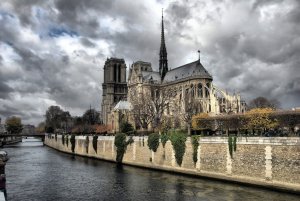
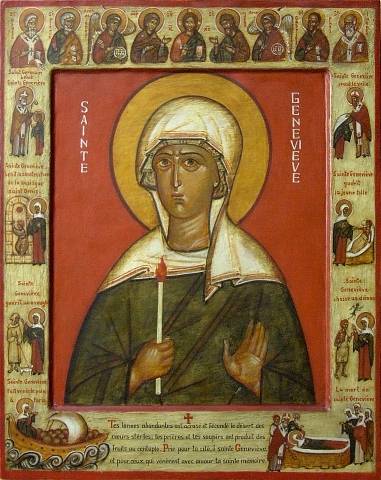
I want to dwell in particular on the life of St. Genovefa (Genevieve) of Paris. When Gallic merchants came to St. Simeon the Stylite, the latter said: “You have the great St. Genovefa.” On top of his pillar he knew that Gaul is the home of St. Genevieve. In the fifth century Attila attacked Paris. The men intended to defend Lutetia, the island on which the Notre Dame cathedral today stands. But at the sight of Attila’s hordes they lost spirit. A young woman, the thirty-year-old Genovefa approached them and declared: “Do not be afraid, but turn to fasting and prayer, and ask God to be saved!” Though they laughed at her, she again admonished them: “Call upon our Heavenly Father, take hold of the arms of prayer and fasting. I predict to you that by doing so, you and your families will be saved.” She was a nun, born in Nanterre. From Nanterre she often went through the woods to the city of Saint-Denis, where the relics of St. Dionysius reposed, and so is often portrayed with the candle that lit her path. The men unexpectedly heeded her appeal. And indeed Attila’s troops, which advanced in two columns, joined up in front of Paris, but for unknown reasons they went around the city.

St. Genevieve of Paris
I want to remind you of words from a sermon by Bishop Nathaniel, that the power of God is shown through those who most clearly, fully, and humbly acknowledge their own insignificance before God, their total dependence on God’s will, and on the good and almighty love of God. They place complete trust in Him rather than in their own strength. All of these qualities are more often present in women than in men, because men have preserved a kind of ancient, pagan, and haughty arrogance. Men feel that they are strong and sturdy, while God’s glory shines more greatly in women through their weakness.
The relics of St. Genovefa were vandalized in 1789 by the revolutionaries. The place and exact boulder on which the relics were burned is known. Likewise, Russian revolutionaries destroyed the relics of saints first of all, taking an example from their French teachers, who immediately destroyed the relics of Paris’s patron saint.

The Return of Orthodoxy to the West

I want to remind you of a decree by St. John [of Shanghai and San Francisco] that asserts that we that who live in Western Europe should locate and venerate local Orthodox saints. Now we commemorate all the martyrs by name: St. Clodoald of Saint- Cloud, St. Germaine of Auxerre, St. Saturninus of Toulouse, and many others. Some time ago, our Archbishop Ambrose of Geneva compiled a service to the Orthodox saints of Switzerland.
Some Orthodox Saints of France are included in church calendars: for example, St. Irenaeus, St. Pothinus, and the Lyon martyrs. At one time during our diocesan conventions, the late Vladyka Anthony (Bartoshevich) had our priests find the names of Western Orthodox saints and include them in church calendars. Now such calendars with these names have been published.
Orthodoxy in France and Western Europe gradually disappeared – later in England, and sooner, the closer to Germany; in our area it happened later due to the influence of England. Orthodoxy returned to Western Europe with the Russians that immigrated here after the Russian revolution, bringing with them the faith that was once here.
Text compiled by Alexandra Nikiforova from audio recordings.
* Tradition says that when the Apostle Paul sailed to Spain, he disembarked near the Byzantine city of Aleria, Corsica. I have been there and the locals showed me the place of disembarkment

Πέμπτη 29 Μαρτίου 2012

Saint Willibrord, Apostle of the Frisons, of Holland, Zeeland, Flanders and Brabant(739+)


The Saint was born in Northumbria in England around 638. At the age of seven he was sent to the monastery at Ripon for education under St Wilfrid (April 24), the abbot.

At the age of twenty he travelled to Ireland to live among the holy monks of that land; he spent twelve years there as the spiritual child of St Egbert (also April 24).

In 690 St Egbert sent Willibrord as head of a company of twelve monks to take the Gospel to the pagan lands around Frisia.

The holy missionary first went to Rome to receive the blessing of Pope Sergius, then with his fellow-monks preached the Gospel throughout Holland and Zeeland.

In 695 Pope Sergius consecrated Willibrord Archbishop of Utrecht, instructing him to organize the Church throughout that area.

As Archbishop, Willibrord continued to labor tirelessly for the spread of the Gospel in those pagan lands; his missionary travels took him as far as Denmark.

He reposed in peace in 739 at Echternach Monastery (located in present-day in Luxembourg), having served for forty-four years as a bishop and for most of his life as a monastic. His tomb soon became a place of pilgrimage.

Kontakion, First Tone

With wreaths of praise let us crown the glorious Willibrord as a luminary who shone forth, a herald who proclaimed the glad tidings of the triune God, an unshakable pillar of the Orthodox Church, and the merciful intercessor for the Low Lands, who abolished the demonic worship of idols therein, and who prayeth to Christ God, that He grant our souls peace and great mercy.

Oikos:

Thou shonest forth in a heathen land as a beacon of holiness, a brilliant lamp of grace, a light shining in the wilderness with the grace of God; wherefore, we who honor thy memory cry aloud unto thee: Rejoice, O holy hierarch, who didst increase in sanctity from thy youth; rejoice, thou who wast vigilant in all things with a good conscience! Rejoice, O most lauded luminary of Christ; rejoice, thou who didst teach all to keep the commandments of God! Rejoice, thou who didst shine forth like the sun, from the West even unto the North; rejoice, thou who, seeing the Frisians languishing in demonic idolatry, didst piously yearn for their conversion to the Faith of Christ! Rejoice, O ever-memorable wonderworker; rejoice, healer of souls and bodies! Rejoice, O Willibrord who art unceasing in thine entreaties to the Lord, that He grant our souls peace and great mercy!

(Source: http://www.abbamoses.com/months/november.html

AN ALTERNATIVE CONSTITUTION FOR THE EUROPEAN UNION:THE LATIN SAINTS OF THE ORTHODOX PATRIARCHATE OF ROME


Fr Dionyius'What a good sign that some Westerners are turning to Orthodoxy. The fact that some are also venerating the saints that lived in the West before the Catholic Schism shows how the Holy Spirit is enlightening them to go back to where they left. The West was with the Orthodox Church until all Seven Oecumenical Councils had taken place. Both Orthodox and Catholics are guilty for the Schism, because both lacked love for each other, but at least the Orthodox kept the Faith. The Schism was the work of Satan, because if we had not been separated, the Christian witness to the world would have been titanic, and the devil would not have turned us to all the things of today'.
Words spoken on 24 July/6 August 2003 by Fr Dionyius (Ignat) of Colciu Skete on the Holy Mountain. Aged 94, Fr Dionysius has been an Athonite monk since 1926.


FOREWORD
In 2004 the European Union will introduce its first Constitution, which from May 2004 will apply to twenty-five European countries. This has been widely, and quite rightly, criticised, throughout the Orthodox and Non-Orthodox world, for its utter neglect of the Orthodox Christian foundations of Europe. On the eve of 2004, we are therefore proposing an Alternative Constitution for the European Union. It is a Constitution of the Saints, a Constitution based on the only true Unity that Europe, East and West, has ever experienced, Spiritual Unity, Unity in Christ. Unlike the secular, humanistic Constitution to be adopted in 2004, this Constitution is about the Re-rooting and therefore Re-routing of Europe, the Reintegration of Latin Europe into the Church after a thousand years of erring.
INTRODUCTION
For centuries many of the greatest Saints of the Latin Orthodox world have been included in Greek, Arabic, Georgian, Slavic and Romanian Orthodox calendars in the multicultural Orthodox world. Here they have been much venerated, although sometimes on different dates from the Latin West.
Thus St Agnes, St Agrippina, St Alexis, St Anastasia, St Sophia and her three children, St Tatiana of Rome, St Agatha of Catania and St Lucy of Syracuse have always been loved by all Orthodox. St Irenaeus of Lyons, St Julian of Le Mans (Cenomansis, 'Kenomaniysky' in Slavonic), St Cyprian of Carthage, St Hilary of Poitiers ('The Western Athanasius'), St Ambrose of Milan, Blessed Jerome of Stridon and Augustine of Hippo, St Martin of Tours, St John Cassian and St Benedict of Nursia have always been honoured as Church Fathers or writers. St Leo the Great, St Gregory the Great (called 'The Dialogist', to whom is attributed the Liturgy of the Presanctified Gifts), St Martin I and many other Roman Popes, so many of whom were Greek or Syrian, have always been revered by all Orthodox. Nevertheless, because in the eleventh century the Western lands separated from the Church, falling under the sway of an organisation founded on the ruins of pagan Rome, these Saints represent only the tip of an iceberg of Latin holiness, which remains largely unknown in the rest of the Orthodox world.
The task of restoring all the Saints of the Latin Orthodox world to Orthodox calendars was begun in 1975 for personal use. At that time we also set about including the names of at least some of the New Martyrs and Confessors of Eastern Europe and Russia. They had then still not been canonised, even by the free part of the Russian Church, the Church Outside Russia. Today the situation is quite different within both the Russian and Serbian Churches, now politically free, who have glorified many of their saints within their own homelands. However, the situation with Latin Orthodoxy is still deficient.
In the 1970's, under the direct influence of St John the Wonderworker (at that time also still not canonised for political reasons), in the English-speaking world only the monastery at Platina in California and Fr Mark (Meyrick) in Walsingham in England were issuing calendars, including at least some saints of the Latin Orthodox world. At Platina, under the influence of the ever-memorable Fr Seraphim Rose, certain Latin saints were included in their St Herman calendar. At Walsingham in England the ever-memorable Fr Mark (later David) was also inserting some Latin saints, though nearly all Celts, into the St Seraphim calendar (which is no longer published). Since then an Old Calendarist group in Austin, Texas has published an Eastern-Western combined calendar under Western-rite influence. Nevertheless, there has until now nowhere been any listing of Latin Orthodox Saints with some basic details of their lives.
Thus we are now continuing and expanding on the three editions of our work, 'The Hallowing of England' published in 1994. We are making use of our articles on Orthodox Iberia (published in 'Orthodox England', Vols 2.2 and 2.3 ). And we are also using articles such as 'Towards the Orthodox Calendar' or 'Towards a World Calendar', published in our 1999 book 'The Lighted Way', in order to present on the Internet a listing of the Saints of the Latin Orthodox world.
LATIN ORTHODOXY
We use the term 'Latin Orthodox', since the term 'Western Orthodox' is too confined geographically. It also has connotations of 'Western-rite'. Even the term 'Western European Orthodox' is insufficient. We use the term 'Latin Orthodox', because the term includes all those holy ones who were part of the Roman Patriarchate. This includes all those who used Latin as a liturgical language, from the Atlantic Celts to the Scandinavian Norse, from the Germanic peoples to the Latin peoples, from Eastern and Central Europe to North-West Africa.
The latter have been particularly neglected. Only the ever-memorable Bishop Nathanael in his reports in 1953 and 1954 to St John the Wonderworker, wrote to any extent about the saints of Latin (North-West) Africa, as opposed to Greek (North-East) Africa, who were centred around the Patriarchate of Alexandria. We should not forget that the native peoples of North-West Africa, the Berbers and their descendants the Kabyls, spoke Latin, not only before the Muslim invasions, but right up until the twelfth century. The best-known representative of Latin Africa, Blessed Augustine of Hippo, was himself a Berber. Even today members of my family who have lived in North Africa and also Kabyl friends, assure me that one of the most common motifs in Kabyl folk-art is still the cross.
Our task here then is to present a catalogue of Latin Orthodox saints, from North-West Africa to the Canary Islands, from Ireland to the Hebrides, from Scandinavia to Poland, from Czechia to Hungary, from Dalmatia to Istria, from Sicily to Malta and all the lands inbetween, including all the lands which then did not exist and were known by different names from those today.
SOURCES
The sources for the insertion of the Saints of Latin Orthodoxy are varied. They are not of course Protestant, since the concepts of 'saints' and even 'holiness' do not as such exist in Protestantism. Even in Anglicanism, there is no definition of holiness and the individuals whom Anglicans put forward for consideration as 'saints' are generally not saints, but social workers and reformers like Florence Nightingale or Dr Barnardo. There one finds great confusion between the emotional, the psychic and the spiritual.
On the other hand, we freely acknowledge our debt to Roman Catholicism. It is Roman Catholicism which for over 900 years has been the depository for the heritage of the Latin West. First of all there are the fundamental learned hagiographical works of the Bollandists on the primary sources, then the secondary Catholic Encyclopedias in various editions and in various languages. To these can be added the works of authors like Alban Butler and Herbert Thurston and more recently David Farmer (The Oxford Dictionary of Saints) in English. We also have to recall the various editions of 'The Book of Saints', published by the Benedictines of Ramsgate in England, to which we owe a large debt of presentation, having first discovered an old edition at the Bodleian Library in Oxford in 1975. However, the most detailed accessible work is undoubtedly the 13 huge volumes, twelve monthly volumes (Menologia) and an Index Volume, of the Benedictines of Paris published by Letouzey and Ane between 1935 and 1958.
However, the problem with Catholic hagiography has always been its inability to preserve, let alone conserve, the heritage of Latin Orthodoxy intact. Even before the eleventh century, mythical and romanced details were being inserted into the Lives of some Saints. This trend accelerated rapidly during the Middle Ages with the production of such 'novels' as 'The Golden Legend'. The reason for this was simply because so many of the Saints of the early Latin world had lived in pre-literate societies. Lives were therefore invented several hundred years after the deeds described, often for purely financial reasons. A second problem is that the whole of the Orthodox First Millennium of Latin Orthodoxy came to be seen through the ideology of Papism. The Lives of many early Latin Saints, especially those of the Popes if Rome, were distorted by the pietism, ideology and philosophy of the Roman Catholic Middle Ages and Counter-Reformation.
A further layer of difficulties arose during the late twentieth century. At that time, under modernising and Protestantising pressures, the Second Vatican Council proceeded to eliminate a large number of saints from the Roman Catholic calendar for whom fictitious Lives had been written. The error here was to claim that a Saint had never existed, just because the Saint did not have a factual Life. However, this rationalisation went even further, hitting the depths of practical atheism. The Vatican actually even began denying the existence of many Saints, including those outside the Latin world and many universal Saints. This came to a head in 1969 with the official revision of the Roman Catholic calendar.
This approach can be termed the 'ABC approach', since it put into doubt the mere existence of such great Saints as St Alexis, St Barbara and St Catherine. Every Orthodox knows from experience that such saints exist, because they answer our prayers and have been seen by more recent saints, such as St Seraphim of Sarov. To forget your ABC, not to be even at the first letter of the alphabet, is about as near to apostasy as one can come. All we can say is that this trend did not always reach the ordinary Roman Catholic people who remained more faithful to the Orthodox heritage of the Latin world than their elite. With this official apostasy in mind, it seems clear to us that the Orthodox Church alone is now able to step forward to preserve, and also conserve in living form, the heritage of Latin Orthodoxy.
CRITERIA
The main criterion for the selection of Latin Saints has to be the date of 1054. Of course, we are sufficiently well-read in history to know that that date has only a symbolic significance, since initially it was the date when the Patriarch of Constantinople was excommunicated by the Pope of Rome for being Orthodox. Nevertheless, though not dogmatic, the date is practical and convenient. Everybody agrees that the Latin West fell away from the Church during the eleventh century, which was not an event, but a process. And everybody would also agree that the first signs of this Schism are clearly visible as early as the end of the eighth century with the Carolingians. However, that Empire failed and the end of the tenth century saw a great many Greek monks and churchmen in Germany, with the Greek Empress Theophano. Again, it is quite clear that there were many contacts between the Orthodox West and the Orthodox East even into the early eleventh century, thus delaying the falling away of the West.
Inevitably, therefore, it is actually impossible to give a precise date for the Western Schism, thus the convenience of the 1054 date. It is notable that in recent years various knowledgeable Orthodox bishops living in Western Europe have given their blessing for the veneration of Latin Saints who lived before the mid-eleventh century. St Genevieve of Paris and St Edward the Martyr are good examples. Moreover, they have given their blessing for the veneration of Saints and the relics of those who lived right up until the first half of the eleventh century - among them, St Olav of Norway or Sts Alphege and Brihtwald of Canterbury. Indeed icons have been painted of these saints, services composed and, in the case of St Olav, in 2003 a church was consecrated.
However, it is also true that we have excluded from the present listing some who lived well before this date of 1054 and included some who lived after. For example, we have naturally excluded from our listing filioquists like 'Blessed' Charlemagne, 'St' Paulinus of Aquilea or 'St' Nicholas I, Pope of Rome. We have had to exclude these and those linked with them, for the simple reason that they were all 'Orthodoxomachists', people who denied and struggled against Orthodox Christianity. On the other hand, we have included in our list those Greeks of Sicily and Calabria who well after the 1054 date continued to live as Orthodox, in communion with the rest of the Orthodox Church, right up until the 13th century and beyond, until they too, like the 14th century opponent of St Gregory Palamas, Barlaam of Calabria, were infected by the Western disease.
We do not wish in any way to suggest that our listing is definitive. There may be figures whom we have wrongly excluded. We ask the Church to decide over the coming years and will adapt the listing in accord with Church consciousness. Like all our work, we do it not to promote some personal viewpoint, but only because no-one else is doing that which is both necessary and inevitable, as the spiritually sensitive in Western lands return to the Church of Christ.
TYPES OF SAINTS
All the saints included here are presented with four basic facts about them. Firstly each has a name (sometimes in different forms), each has a feast-day or days, each has the date when he/she lived and reposed and finally to each is attributed a modern country or region (or countries), on the territory of which they lived. It will soon become apparent that these saints often lived in more than one country or region, for people of that age travelled far more than we realise. Indeed, readers will soon see that many of the saints of the Latin West, including many Popes of Rome, were Eastern in origin, but travelled and were hallowed in the West. The stream of Orthodox from the East settling in the West only dried up in that fateful period immediately before 1054.
In this context, we understand of course that most modern European countries do not correspond to the countries where most of the Orthodox saints of the Latin world lived. To talk of France instead of Gaul, or England instead of Britain, in the fourth century is of course an anachronism. To speak of Portugal, Belgium and Germany in the seventh century equally absurd. However, we take it as understood that the inclusion of the name of a modern country or region (even when its location is well-known) is merely meant to be an aid to the contemporary reader. By pressing 'Control' and 'F' on a keyboard and typing in a key word, any reader can obtain a listing of, for instance, all the Orthodox saints of Sardinia. The same technique would also allow a reader to establish a listing of the Latin saints for any particular day in the Church's Year.
Such key words of countries and regions include: North Africa (meaning North-West Africa, mainly Algeria, Tunisia and Morocco), the Canaries, Portugal, Spain, Catalonia, France, Auvergne, Monaco, Brittany, the Channel Islands, Britain, Cornwall, England, Wales, Anglesey, the Isle of Man, Ireland, Scotland, Norway, Sweden, Denmark, Poland, Germany, Bavaria, Luxembourg, Holland, Belgium, Switzerland, Austria, Czechia, Pannonia, Hungary, llyria, Dalmatia, Istria, Italy, Campania, Tuscany, Umbria, Lombardy, San Marino, Sicily, Sardinia, Corsica and Malta.
As well as this, the reader will realise that individual cities and monasteries can also be consulted in the same way, for the saints gathered in hallowed centres, forming a Constitution, a Spiritual Map of Europe. Such cities and monastic centres include: Rome, Milan, Ravenna, Aquilea, Benevento, Ancona, Verona, Brescia, Pavia, Spoleto, Todi, Capua, Montecassino, Subiaco, Cordoba, Seville, Toledo, Lerins, Vienne, Lyons, Clermont, Autun, Le Mans, Auxerre, Fontenelle, Laon, Toul, Verdun, Metz, Luxeuil, Agaunum, Einsiedeln, St Gall, Maastricht, Trier, Cologne, Canterbury, Glastonbury, Lindisfarne, Iona, Bangor, Clonard.
We can distinguish three types of Latin saints, categorised by their Lives or absence of them.
Firstly, there are those for whom we have no Life. These include many of the Celtic saints and early martyrs and bishops of Gaul (France) and Italy. Many lived in pre-literate societies, where there was nobody to write their Life. Alternatively, many early martyrs and bishops were honoured as saints, but again nobody was able to write down their Lives, for the witnesses of their martyrdoms were themselves martyred. Often, the reader will find entries like 'Martyrs in Rome', or 'A holy woman in Cornwall' or 'An early Bishop of Verona in Italy'. Often this means that we know no more about that saint than the facts given here. It means that the saint existed, but that the pre-literate societies in which they lived managed only to guard their names, where they lived, the centuries when they lived and their feast-days.
Secondly, there are those saints, similar to the first, but whose Lives were written many hundreds of years after they lived, in the forms of medieval romances. Frankly, most of this hagiography has to be rejected as pure invention - that was the error of medieval Catholicism. This does not mean that we reject the existence of the saint, that the saint's intercession cannot be sought in prayer - that was the error of modern Catholicism. Rather, all this merely means that we reject the efforts of a medieval fiction-writer to bestow on a saint who lived perhaps 700 years before, a Life. Instead, we guard the real facts, however meagre, of the real Life of the real saint.
Finally, there are those saints about whom we have detailed and factual Lives. For example the Acta of many of the early martyrs survive intact and are very edifying and very moving. We can think of the Acts of St Perpetua and Felicity and Companions as an example. Later, many early saints had a disciple who wrote down Lives almost immediately after the repose of their spiritual fathers. St Cuthbert and St Guthlac are good examples from England. Here the reader who wishes to know more is invited to do further research and reading. Unfortunately, in our position as pioneers in poverty, we are unable to do this. Perhaps the new Hagiographical Institute in Moscow will in future years be able to see to the editing and publication of Volumes of Lives of the Latin Orthodox Saints. The recent 2003 Conference in Moscow on the Pre-Schism Western Saints bodes well for this.
CONCLUSION
At this point, we would like to express our thanks to two Orthodox friends who have recently worked very hard on this project: our webmaster David Davies and our great helper Eadmund Dunstall. Without their help, this project would never have seen the light of day on the Internet. As regards a printed form, we have patiently been awaiting a wealthy sponsor since 1975!
It remains for me to state the obvious. This project is not complete. And it never will be. We have never had the intention of providing a listing of all the saints of the Latin West. They are known to God alone. Here we provide some 10,000 entries, either for individuals or else for groups, more or less numerous, of Saints. But we can hope and pray:
We can hope that at the Last Judgement, through the prayers of all the saints, we shall be forgiven our sins, and then in eternity come to know the saints of God, not 'in a mirror darkly, but face to face'.
And we can pray all the more ardently on All Saints Sunday and ask those who have not been included here for their revelation to us.
Hope and prayer have alone allowed to live to this day.
AFTERWORD
At the dawn of 2004 and a new Europe, we are putting forward an Alternative Europe and an Alternative Constitution for that Europe. Our Europe is not that of corrupt power elites and their politico-business mafias, but a Europe of Spiritual Unity in the Saints of God. The Constitution of the Saints of Latin Orthodoxy is a Constitution of the grassroots, a Latin Europe in communion with all that is best in herself. And as it is a Europe in communion with her Age of Saints of the First Millennium, it is also therefore a Europe once more in communion with the rest of the Orthodox Church, as of old.
The choice before us is now clear:
A Secular Europe, divorced from God, built on the failed thousand-year experiment of the fallen humanist ruins of Catholicism/Protestantism, in communion with the rest of modern secularism.
An Orthodox Europe, partaking of the Holy Trinity, renewed on the holy two-thousand year reality of the risen spiritual heritage of the Saints of Latin Orthodoxy, in communion with the rest of the Orthodox Church.
We long ago made our choice and pray that others will follow us.


Fr Andrew Phillips
St Felix and St Edmund Orthodox Church,
Felixstowe,
England.


St Theodore of Tarsus, Archbishop of Canterbury