Τετάρτη 17 Απριλίου 2013

Western Orthodoxy


Both eastern and western Christians, on first hearing of Western Orthodoxy, often ask such questions as “Who are these people?” or “Why haven’t I heard of them before?”

First, who are Western Orthodox Christians? Simply, they are those Christians of the West who have discovered the truth of Orthodoxy and who have embraced the Orthodox faith and now worship and practice their Orthodox faith according to the venerable and ancient traditions of the West – traditions whose roots go back to that time when the Western Church was still fully Orthodox. Many westerners who have embraced Orthodoxy have known it only in its eastern forms, primarily because these have been the predominantly visible forms of Orthodoxy in the West.

Particularly in North America, with its manifold Eastern Orthodox Churches sprung from foreign lands, a westerner seeking Orthodoxy almost inevitably has turned to a Church whose expression of Orthodoxy is eastern and Byzantine. For thousands of western Christians seeking refuge in Christ’s true Church, these eastern Churches have provided a home. These Christians have welcomed and embraced the liturgical, cultural, and (often) linguistic forms of Byzantine Christianity, and of them little further need be said here, except to note the fervor of their faith and commitment, and their eagerness to share the spiritual treasure of Orthodoxy with their fellow westerners.

Some other western Christians, seeking a home in Christ’s holy Orthodox Church, have traveled by a different route. These Christians, convinced of the fullness of truth of the Orthodox faith, have been encouraged by those Orthodox hierarchs whom they approached, to retain and use the western liturgical, cultural, and linguistic heritage they have been used to, but purified of any elements inconsistent with the Orthodox faith. These Christians, fully Orthodox in their faith, but following a traditional western observance blessed by the Orthodox Church, may properly be called Western Orthodox Christians. They should be so called, first, to distinguish them verbally from those Orthodox in the West who follow eastern observances; and second (and far more importantly), to distinguish them from those they seem, superficially, most to resemble: Roman Catholics, Anglicans, Old Catholics, and those other westerners who are not members of the Orthodox Church.

In the middle of the nineteenth century, some western Christians, sensing the deterioration of western Christianity — whose roots within the true Church of Christ had been severed at the time of the Great Schism in 1054, but whose branches and fruit have taken centuries to wither and visibly deteriorate — began to seek their home in the Orthodox Church, the Church which the Holy Spirit had preserved in fidelity and grace in the East.

In approaching Orthodoxy, these western Christians (most of them Anglicans and Old Catholics separated from Rome) met wise and holy Orthodox bishops whose vision of the venerable and valid liturgical heritage of the West had not been dimmed or distorted by centuries of separation. Most notably, in 1870 the hierarchs of the Holy Synod of Russia approved in principle the return of western Christians to Orthodoxy with retention and use of the venerable liturgical and spiritual traditions of the West, insofar as these were not in conflict with Orthodoxy. This recognition of Western Orthodoxy was not to flower for another few generations, but the seed had been planted and blessed. In the first decade of the twentieth century, upon the initiative of the future Patriarch of Moscow, St. Tikhon, then archbishop of America, the Russian Synod again approved western-rite Orthodoxy in its Anglican expression.

In the later twentieth century, on a larger and wider scale, western Christians in approaching Orthodoxy have found themselves the happy inheritors of this blessing and have harvested its fruits. There are now communities of Western Orthodox Christians within the Moscow Patriarchate, the Russian Orthodox Church Outside of Russia, the Patriarchate of Antioch, and several other jurisdictions.

In 1937 in France, a group of Old Catholics returned to Orthodoxy, retaining their western liturgical use and customs, first under Russian jurisdiction (the Moscow Patriarchate and the Russian Church Abroad), and then under the Romanian Patriarchate, as the Orthodox Church of France. These Western Orthodox use a rite based on older Gallican models, tested and approved by their Bishop at the time, now Saint John Maximovitch.

In Holy Week of 1961, on the authority of Alexander III, Patriarch of Antioch, Archbishop Anthony Bashir received Father Alexander Turner and his Old Catholic parishes into the Antiochian Orthodox Church, authorizing them to retain their western rite and usages. Upon the repose of Father Turner, Father Paul Schneirla was appointed to oversee the Western Rite Vicariate within the Antiochian Church. There are now a number of parishes under this authority throughout the United States. Some of these use a Liturgy based upon the original 1549 Anglican Book of Common Prayer, (often called the “Liturgy of St. Tikhon”) while others use the rite of the Mass as celebrated in the Roman Catholic Church (often called the “Liturgy of St. Peter” or “Liturgy of St. Gregory”). This rite of the Mass was familiar to all Roman Catholics until they discarded it in the wake of Vatican II and substituted for it the revised Novus Ordo liturgy now used in almost all Roman Catholic parishes.

As discussed in Our History: From Mount Royal to Christminster, the nucleus of what became the Monastery of Christ the Savior was received into the Russian Orthodox Church in 1962.

All of these Western Orthodox communities celebrate their Liturgy (the Mass) in the vernacular – English in the United States and Australia, French in the Orthodox Church of France – but freely use Latin, the traditional liturgical language of the West, in their rites. All of them also use the traditional Gregorian Chant (and other western chants, such as the Ambrosian and Mozarabic) as well as suitable liturgical music of other periods and places.

Why have these people become Western Orthodox? What do they find in their Church that cannot be found in the Roman Catholic, Anglican, or Old Catholic Churches of the West? Quite simply, they have found the Church of Christ — His one, holy, catholic and apostolic Church — and have wanted to be a part of it, knowing that Christ calls all people into His one true Orthodox Church. They have discovered that their former western churches have abandoned, in varying degrees and in different stages, the true Christian faith and have wandered from Christ’s truth. Even the once seemingly monolithic Roman Catholic church has begun visibly to display that inner disintegration it embarked upon when it broke from Orthodox unity in 1054. Other western churches, being offshoots of the Roman church, appear to be suffering the same disintegration.

Orthodox Christians, both of East and West, are not surprised by this further falling away of the western denominations into novel and bizarre revisions of Christian faith and morals. Orthodox Christians understand that, apart from sacramental unity in the faith of the one Orthodox Church, no true spiritual unity or integration is possible. Orthodox Christians are grieved at the pain of their western brothers and sisters who must suffer the disintegration and chaos wrought by their denominations’ abandonment of true Christianity – grieved and sympathetic and sobered. For Orthodox Christians know that it is only by God’s grace that they have been called into the safe haven of God’s true and unchanging Orthodox Church and have been given the precious gift of the true faith.

Orthodox Christians hope and pray and long for the return of their separated western brothers and sisters to the haven of Christ’s true Orthodox Church. Western Christians need to know that, despite the chaos and distress and confusion within their denominations, Christ’s holy Church is alive and well and vigilant in maintaining the true faith once delivered to the Saints. In Western Orthodoxy, with its forms, rites, and traditions so familiar to western Christians, Christ’s Orthodox Church, welcoming its prodigal western sons and daughters, can provide them with a sense of truly coming home to their Father’s house.

Western Rite Monastics


Western Rite Monastics
TOWARD A POLICY ON WESTERN-RITE BENEDICTINE MONKS
In light of several developments over the course of the past few years, it has become clear that some formal and definite policy needs to be observed within the western rite of ROCOR with regard to the status of monks in general and Benedictine monks in particular.
It has become clear through our experience at Christminster, with the long-term stay of several eastern-rite monks, that there is a great difference between an eastern monastic and a Benedictine. This difference has little, if anything, to do with rite, but entirely with monastic formation and philosophy.
The Holy Rule of our father Saint Benedict is a well-tested classical foundation for a solid and sane monastic life. Its genius has been tried and recognized over centuries and its wisdom is unquestioned – at least this is so among western-rite Orthodox Benedictines. In his Rule, Saint Benedict makes clear that his monasticism is clearly a cenobitic one, for monks in community. His scorn for solitary gyrovagues, loosely defined “monks” and premature hermits is unquestionable
His Rule is based on the principle that one works out one’s monastic vocation, not by oneself, but precisely through and within the dynamics of a stable and specific community. To this community an aspirant is first of all to be denied easy admission, and the difficulties of living in community are to be firmly pointed out to him. He is in fact to be at first heartily discouraged from a monastic vocation, and is to have all the dura et aspera of the vocation made clear.
The reason for this is that, like marriage, the monk is entering into a new and communal life that requires the shedding and indeed the death of the former individual self and the growth and formation of a new monastic self-in-community. This is accomplished, as in marriage, by solemn commitment to stability, continual reformation of life, and obedience – the three vows of the Benedictine monk. As with the marriage vows, these bind the monk, until death, to one specific monastic community, to the daily reformation of life in that community, and the continual subjection of every individualistic and selfish element to the will of another – this being the Rule, the Abbot or the demands of communal life itself, especially the demands – and they are demands – of charity and humility toward one’s brethren.
Obviously this wise and well-programmed discipline is not to be taken or entered into lightly, no more than a marriage would or should be. And the disasters of entering marriage unprepared for its self-reforming discipline are clearly and widely seen in our society. So are the disasters of entering the Benedictine life and discipline lightly or unadvisedly or without the clear presence and direction of a community and abbot.
The formation for this difficult discipline of life may take several years within community before the monastic is allowed to make his formal commitment for life. But once he does it is – like marriage – a commitment to this Rule, this community, and monastic obedience for better or worse, richer or poorer, in sickness and in health, etc., until death.
Thus to presume that one can become a monk instantly or with no long preparation and formation within a specific Benedictine community and under the Rule and direction of an abbot – is a formula for failure and is seriously disrespectful of the tried and true tradition of Saint Benedict and his Rule.
If an eastern-rite monk, of however long standing, wishes to become a Benedictine monk, he must undergo the formation and discipline required by Saint Benedict and his Rule. He must be examined, like any other candidate, for a capability and aptitude to live the life in a specific community.  It would be entirely unfair, to both the individual and the prospective community – as well as to western-rite Benedictine monasticism – to presume a readiness for this monastic discipline and life and not to test it as Saint Benedict requires.
Therefore, in light of all this, the following policies would seem to be advisable:
·         No eastern-rite monk may become a western-rite Benedictine monk without undergoing the full admission and formation procedures of the holy Rule within a specific community.
·         No priest or layman may become a western-rite Benedictine monk without undergoing the full admission and formation procedures of the holy Rule within a specific community.
·         Final and formal admission, as indicated in the Rule, is the prerogative of the abbot and monks of the specific community.
·         There are no Benedictine solitaries or hermits or “free-lance” monastics.
·         All western-rite Orthodox monastics are affiliated with and live within one of the two established Benedictine monasteries within ROCOR: Our Lady of Mount Royal or Christ the Saviour (Christminster)." 
·         Lay men and women as well as celibate or married clergy may be affiliated with either of these communities as Oblates, following their acceptance as such and following the Oblate Observances of their monastery. These may be permitted, under stated and specific conditions, to wear the oblate habit, but are in no way to hold themselves forth as full monastics.
·         As the need appears, new Benedictine monasteries may grow out of the established ones (Our Lady of Mount Royal or Christ the Saviour) and will consist of some fully formed monastics of these communities.

Τρίτη 16 Απριλίου 2013

The Orthodox Western Rite


Before the year 1054 there would have been no difficulty in declaring that the Western Rite of the Undivided Church was simply the use of Latin speaking Churches. The Rite used by Christians in Scotland, Ireland and England, was as Orthodox as that used in Constantinople. In the first thousand years of Christendom all the far flung churches that were in communion with the Five Patriarchates (Constantinople, Jerusalem, Antioch, Alexandria, Rome) were Orthodox. After 1054, and more precisely, after the Norman Conquest (1066) of England, the Churches of the West were drawn into the Great Schism of the Roman Patriarchate away from the Unity of the Orthodox Church. The Western Liturgy came to reflect the Papal errors and even incorporated the Filioque in the Nicene Creed with other aberrations.The restoration of a corrected, and truly Orthodox, Western Rite to Holy Orthodoxy in the United States was not originated by laity or by ordinary clergy. The vision of the Western Rite as an essential part of the Orthodox Mission in America belonged toArchbishop Tikhon of the American Archdiocese under the Moscow Patriarchate. About ninety years ago he examined the existing Anglican Book of Common Prayer and sent it to the Holy Synod of Moscow. That Liturgy, derived from the ancient use of the Orthodox West, and first expressed in English in the edition of 1549 by authority of King Edward the Sixth of England, was corrected and approved by the Holy Synod for Orthodox Church use.
In the years following, blessed Tikhon was himself elevated to Patriarch of Moscow, martyred by the communists in 1925, since declared a Saint of the Church, and thus known to Orthodox faithful throughout the world as St. Tikhon, Enlightener of America. This is the same Saint Tikhon who, about the time he obtained approval for the restoration of the Western Rite in America, also consecrated (in 1904) Raphael Hawaweeny to the episcopate of the Orthodox Church of North America, from which the Antiochian Orthodox Christian Archdiocese descends.
As the Orthodox Mission in America grew in numbers and in maturity, further authorization of the Western Rite was given by the Patriarchs and Holy Synod of Antioch. Metropolitan Anthony (Bashir) founded the Western Rite Vicariate for the creation of Western Rite Missions and Parishes in the Archdiocese. Metropolitan Philip (Saliba) has promoted an increasing number of Western Rite Parishes throughout North America; and new additions of Clergy and Laity to this world have more than doubled its size in a few years. Western Rite Orthodoxy is now a rapidly growing dimension of the Church's Mission in America.
The Western Rite Parishes represent a restoration of the legitimate Western Liturgy of the Undivided Church of the first 1,000 years, by Patriarchal authority, for the benefit of all Orthodox people.

Introductory Articles on the Western Rite

What is Western Rite Orthodoxy?
An article featured in the May 1993 issue of The Word, by Fr. Patrick McCauley, of blessed memory. If you are new to Western Rite Orthodoxy, read this first.
The Twain Meet
The Very Rev'd. P.W.S. Schneirla's guest editorial in the May 1993 issue of the Antiochian Archdiocese publication The Word. Fr. Schneirla is the Vicar General of the Western Rite within the Antiochian Archdiocese.
The Western Rite—Its Fascinating Past and Its Promising Future
An in-depth introductory article on the Orthodox Western Rite by the first Vicar General of the Western Rite, the Right Rev'd Alexander Turner, SSB.
An Introduction to Western Rite Orthodoxy
An electronic version of the now out-of-print Conciliar Press booklet; edited by Fr. Michael Trigg, Ph.D.
An Introduction
By Fr. Alexis Young
Why Would an Episcopalian Become Orthodox?
By Fr. Patrick McCauley, of blessed memory
Finding a Home in Western Rite Orthodoxy
By Fr. John Charles Connely
Orthodox Odyssey
By Fr. John A. Mangels
Our Plea
By Fr. Michael Trigg

Apologias for the Western Rite

Lux Occidentalis (PDF)
Subtitled: The Orthodox Western Rite and the Liturgical Tradition of Western Orthodox Christianity, with reference to The Orthodox Missal, Saint Luke's Priory Press, Stanton, NJ. 1995.By the Rev'd John Charles Connely M.A, Dean of the Central and Mountain States and Rector ofSt. Mark's Parish. If you don't have Adobe Acrobat Reader, you can't read this beauteous .PDF version of the article. You can download Acrobat Reader for FREE.
Comments on the Western Rite
By His Grace, the Right Rev'd Bishop BasilYou are the inheritors of a precious treasure: the authentic and Orthodox rites that nourished thousands now in the Kingdom of heaven. The Orthodox Church thanks you for preserving this tradition all these years, so that it could be restored to her through Western Rite orthodox parishes.
Doctrinal Issues: Western Rite Orthodoxy
From Diocesan News for Clergy and Laity, the official newsletter of the Greek Orthodox Diocese of Denver, headed by His Eminence Metropolitan Isaiah under the Ecumenical Patriarchate of Constantinople. This short article illustrates that not all Greek Orthodox bishops share the same view of the Western Rite that His Eminence Metropolitan Anthony of San Francisco does…
The Causes of the Debacle of the Modern Roman Catholic Liturgy
This article by Monsignor Klaus Gamber is fairly uncatagorizable, but is placed under theApologia section to explain why Western Rite Orthodoxy insists on pre-Vatican II usage, and why our mission to Western Christianity is especially urgent.

Western Orthodox History

An Excerpt from the Report of Metropolitan Anthony (Bashir) to the 1958 Archdiocesan Convention
On 31st May 1958, His Beatitude, Alexander III, Patriarch of Antioch of blessed memory, in consultation with the heads of the other autocephalous Orthodox churches, authorized His Eminence Metropolitan Anthony (Bashir), of blessed memory, to establish the Western Rite in theAntiochian Archdiocese. Originally from the November 1958 issue of The Word, reprinted in theLion.

Western Orthodox Customs, Devotion and Piety

Some (More) Things While You Should Know in Church
A shorter version of this article was originally published in the Word magazine. Written as a follow-up to a prior Word article by Fr. David Barr on customs and practices in Orthodox churches, this article highlights some customs of the Western Orthodox parishes in the Antiochian Archdiocese.
The Orthodox Christian Society of Our Lady of Walsingham
Information on this society within the Western Rite Vicariate. The purpose of the Society of Our Lady of Walsingham is to encourage devotion to the Theotokos, the Blessed Virgin Mary, under this, one of her most ancient Western titles, and to work for the upbuilding of the Orthodox Christian Church.
The Rosary and Orthodox Christian Devotion
A short article from The Walsingham Way, Vol. II, No. I, Fall 1999, a newsletter of Western Orthodox spirituality published by the Orthodox Christian Society of Our Lady of Walsingham.

The Next Western Rite?


Here's an interesting news item: an Orthodox metropolitan has been invited to deliver a keynote address to a group of conservative Anglicans in the formative stages of "a new denomination." News reports described the formation of the Provincial Assembly of the Anglican Church in North America (ACNA):
After years of preparation, evangelical, orthodox and traditionalist Anglicans from across North America, many of them recently departed from the Episcopal Church, will meet in Texas this week to formally launch the new denomination. ACNA unites eight Anglican groups under a single Archbishop and positions itself as an alternative to the U.S. Episcopal Church within the global Anglican Communion.
It is fascinating whom they wanted to hear from:
Ecumenical speakers including Pastor Rick Warren of Saddleback Church in California and Metropolitan Jonah of the Orthodox Church in America will offer keynote addresses.
In fact, Met. JONAH will speak later today at 10:30 a.m. to noon CDT. It appears you can watch his speech live here.

His Eminence certainly makes an interesting contrast with Rick Warren. (Warren is author of The Purpose Driven Life and a favorite ofthe ACNA's evangelical members.) Despite boasts of their alleged death, there are yet a number of Anglo-Catholics who rejoice that, in their view, the ACNA constitution affirms "the Seven Ecumenical Councils" and its "Canons recognize that we embrace the faith 'once for all delivered to the saints' of the One, Holy, Catholic and Apostolic church." They may not know they are seeking the Western Rite of the Orthodox Church, but they are.

And Met. JONAH surely knows.

As a former Episcopalian, His Eminence has personal insight into their views. It is also significant that just this April Met. JONAHacknowledged, "It doesn't matter if we Eastern Rite or Western Rite, doesn't matter the language in the service is...we are one indigenous Church." This is in accordance with the views of someRussian New-MartyrsSt. Tikhon (Bellavin)St. Nicholas of JapanSt. Raphael of Brooklyn — and even of the OCA's own founding hierarch.

One can hardly say this meeting will result in new waves of Western Rite Orthodox, though it cannot hurt. As I have noted, Anglicans are largely impervious to moving anywhere, no matter the difficulties, and there are many places easier to enter than Orthodoxy, much less the Western Rite of Orthodoxy.

It is good this meeting of traditionally minded Christians did not go wtihout an Orthodox voice. Perhaps as the speech commends their step of faith away from apostasy, it will show them the limitations of the ACNA: it has essentially restored a slightly more conservative status quo of 1979. In addition to being a big tent church open equally to "Puritans and papists" (to paraphrase Fr. Alban Waggener), fully one-quarter of its dioceses allow women's ordination to the priesthood. The ACNA's Anglo-Catholics write its constitution will not force priestesses upon any diocese, and parishes will retain their property rights...but the fact remains: this is not the faith of their fathers. That can be found only in the Holy Catholic, Apostolic, and Orthodox Church. Lord willing, this will prove a first step to that destination.
Labels: 

Δευτέρα 8 Απριλίου 2013

ORTHODOX SAINTS WHO EVANGELIZED GERMANY AND AUSTRIA


A sincere attempt is being made with this new series by our website, to now acquaint our readers with the lives of the Orthodox Saints and Martyrs of the original One, Holy, Catholic and Apostolic Church of our Lord, who, like some of the Orthodox Saints of the British Isles, lived and propagated the Faith in the Western territories of the European Continent during the first millennium of Christianity and prior to the Great Schism of 1054 AD.

Saint Rupert (Robert) of Salzburg, Apostle to Bavaria and Austria († 710)
March 27th is the feast of St Rupert, a most holy and blessed man. This feast commemorates the day of his repose, which brings spiritual joy to devout minds and refreshes hearts throughout the entire year. As the Scriptures say, “The righteous shall be in everlasting remembrance.” He who passes into the angels’ joy is made worthy of men’s remembrance: as the Scriptures say, “A wise son is the glory of the father,” and how great is his glory, who redeemed so many barbarian nations through the knowledge of God in Christ Jesus through the Gospel!
When Childebert the king of the Franks was in the second year of his reign, the Bishop of Worms was the Holy Confessor Rupert, who was born into the ranks of the Frankish nobility, but was far more noble in faith and piety. He was gentle and chaste, simple and prudent, devout in praise of God, full of the Holy Spirit. He was also circumspect in his decisions and righteous in his judgment. He possessed great spiritual discernment, and his good deeds formed his flock into true images of Christ, for he inspired them not only with his words, but by the example of his works. He often kept vigil, weakened himself with fasting, and adorned his works with compassion. He gave away his riches that the poor might not go hungry, believing himself to be one who should clothe the naked and help the destitute.
When the great fame of this most venerable man had spread to the ends of the world, powerful men, not only in that region but from other nations, poured in to hear his most holy teaching. Some with many sorrows came to receive consolation through his holy words, and other churchmen came to learn the purity of true Orthodoxy from him. Many were freed from the snares of the ancient enemy by his loving spiritual advice, and were able to set out on the path to salvation. But unbelievers, who were numerous in the vicinity of Worms, not understanding his holiness, exiled him from the city in a most shameful manner. They caused him terrible suffering and beat him with rods. At that time Theodo, the Duke of Bavaria, hearing about the miracles which this most holy man had performed and of his blessedness, desired to meet him. With firm resolve he dispatched his most trusted men to summon him to his court and to enquire of him how long might he consent to visit the regions of Bavaria, and could he instruct him in the way of life-giving faith? The blessed bishop, having received such a sincere and heartfelt request knew that it came from Divine dispensation and thanked the Merciful One, because “those who sat in the darkness and the shadow of death” longed to know the author of life, Jesus Christ.
As a result of this he sent his own priests, as if they were rays of faith, to return with the ambassadors of the Duke, and he himself after a short time undertook the journey to Bavaria. When the Duke heard the news that the blessed one was on his way he was overcome with great joy, and he and a large retinue hastened to meet St Rupert, overtaking the saint in the city of Regensburg. Although exhausted and hungry from his long journey, St Rupert, right away began to reveal to the Duke the mystery of the heavens and instructed him in the Orthodox faith. He convinced the Duke to renounce the worship of idols, and baptized him in the name of the Holy and Indivisible Trinity. The nobles and the simple people were also baptized with the noble duke, praising Jesus Christ the Saviour of the world, who considered them worthy to be called wondrously into His light from their darkness through His confessor, the most blessed Rupert. By his holy words their darkened hearts were enlightened and the souls of the unbaptized thirsted for the fountain of life.
When the saint had revealed Divine Truth by having baptized the Duke and his people, Theodo came to understand the mystery of saving baptism. He begged the holy Rupert to carry the light of Orthodoxy to others and the saint, fulfilling his desire, boarded a ship and sailed down the River Danube. Through the towns, villas, and forts, he declared the gospel of Christ in a great voice. To the ends of Noricum, into the lower parts of Pannonia, he brought the light of the teachings of Christ which illumines all. Having returned by land, he entered Lauriacum (torch on the River Enns), in whose water he baptized many, freeing them from the worship of idols. In the name of Jesus Christ he healed many who had been oppressed by various illnesses and passions. After he left Lauriacum he saw the spiritual darkness of the tribes in that region; he boldly undertook to smash images and to proclaim everywhere the divinity of the Lord Jesus Christ as well as His most holy incarnation. He brought them to believe that He truly is both God and man, truly begotten of the Father before all ages. He taught them that Christ is the Word of God conceived by the Holy Spirit and born of the Virgin Mary for the salvation of mankind.
Having accepted the episcopacy after being entreated to do so by the Duke and his people, he went to the placid waters of Lake Wallersee, where a church had been built in honour of the chief apostle Peter. He moved from there to the Juvavian (Salzach) River, the site of the city of Juvavia, which had been erected in ancient, tumultuous times. At one time it had had great importance among Bavarian cities, but by the time St Rupert arrived it had become overgrown with trees and weeds and only a few people lived among the ruins. The servant of God considered this a suitable place for his episcopal cathedral, because being situated high in the mountains, it was far from the tumult and distractions of crowds. He went before the duke, and spoke to him with great enthusiasm about his plan to build a basilica there in honour of the blessed Peter, Chief of the Apostles. He was granted the vast sums needed to build the splendid church by the generosity of Theodo. When the church was finished he ordained priests, and commanded them to celebrate the daily offices in canonical order. The saint of God then wished to enlarge his holdings in the vicinity of the cathedral, so he petitioned the Duke for yet another donation, and with the funds donated to him he purchased the estate known as Piding for thousands of solidi, a great sum of money at the time. Thus, by the will of God and the bequests of kings, noblemen, and the faithful, the centre of spiritual life for the kingdom began to grow.
Here is an account of a wondrous event in the life of St Rupert. Some very reliable men came to the blessed hierarch and told him of an amazing phenomenon which had taken place when they had gone into an unnamed wilderness area now called Bongotobum (Pongau). Three or four times they had seen heavenly lights shining like bright lamps in the sky and they had also experienced a wonderful fragrance in the same place. The pious bishop sent the priest Domingus to Bongotobum because of the reports which he received concerning these lights. It was his desire that the priest would verify the authenticity of these wonders by erecting in that location a wooden cross which the holy one had made and blessed with his own hands. When Domingus arrived, he at once began the First Hour with the monks who had come with him. They saw a bright heavenly light which descended from the sky and lit up the entire region with the brightness of the sun. Domingus saw this vision on three nights in a row, and experienced the wondrous fragrance as well. He erected the blessed cross in that place, and it was miraculously transported to a spot above the dwelling of St Rupert, confirming the truthfulness of what had been reported to him! St Rupert took word of the miraculous occurrence to Theodo and then he himself went into the wilderness to the very spot, and seeing that it was suitable for habitation, began to cut down aged oaks and brought in building materials that he might build a church with dwellings for a monastic community..
At about the same time, Theodo fell into ill health, and felt the end of his life approaching. He called to his bedside his son Theodobert, appointing him the Duke of Noricum, admonishing him to be obedient to St Rupert and to aid him in his holy work as well as to firmly establish and support the Juvavian church with love, honour, and dignity. He also adjured him to protect and exalt it. When he had instructed his son in all good things and had given him his final testament, he ended his earthly life and fell asleep in the Lord. After the repose of his God-fearing father, Duke Theodobert along with his nobles remained followers of St Rupert because of his great sanctity. Having travelled to see the saint in his far hermitage, the duke honoured him with pious affection and went to pray in the church which the saint had built there. The duke donated three parcels of land in honour of St Maximilian and gave property on all sides of the forest, as well as an estate in the Alps. He gave gifts to support the monastery and the hieromonks whom the most blessed Rupert had ordained for the Service of God.
When this had been accomplished, the man of God saw that the most noble man of Bavaria had submitted himself to the yoke of Christ and had left worldly concerns to the lesser men of his kingdom. St Rupert then accompanied the duke back to his homeland and then returned with twelve of his closest spiritual children (among whom were Kuniald and St Gisilarius, both priests and both holy men). His niece, St Ermentrude, a virgin dedicated to Christ also accompanied them to the city of Juvavia. There in the main fortress of the city he built a monastery in honour of Our Lord Jesus Christ the Saviour and His Most Pure Mother, the Ever-Virgin Mary. He placed as abbess in that monastery St Ermentrude, that she might serve the King of Heaven. With the generous support of Duke Theodobert, who gave many gifts to the nuns, he established a monastery which had all its spiritual and physical needs well taken care of.
When all this had been accomplished, the blessed man became eager to complete the missionary efforts he had begun with the help of Christ. Accompanied by clergy and monastics, he resolved to visit his followers in the Norican kingdom. Having left the city of Juvavia he visited people on whom the light of faith had not yet shown, and he sowed the wheat of faith amid tares. The deception of the devil fled from the hearts of these barbarian tribes, and Rupert sowed in its place faith, love, mercy, and humility, for through these Christ, the giver and source of all good, is able to take up residence in the human heart. He travelled to all the ends of Bavaria, and converted the people to faith in Christ, and strengthened those who had remained steadily faithful. Having sent out several priests and men of God who brought the Divine Mysteries to the people, he became anxious to return to Juvavia. Because he had the gift from God of knowing the future, he knew that the day of his repose was at hand. He revealed this to his disciples, who were filled with sorrow and anguish. Because of this, there was much weeping and great mourning when he took leave of his newly enlightened Christian flock.
Filled with certainty and faith in Christ, St Rupert commended the city, the Norican people, and all who had been received into holy Orthodoxy to the Most High and All-Knowing God. He chose Vitale, a holy man whom the people themselves had accepted, as his successor. When the forty days of Great Lent had passed, Bishop Rupert became very ill and was exhausted by a high fever. When the most holy day of the Resurrection of Our Saviour Jesus dawned, he celebrated the solemn Liturgy, and was fortified for his final journey with the precious Body and Blood of Christ. He comforted his priests, monastics and flock with a beautiful sermon filled with much love. Then, surrounded by his weeping spiritual children he breathed his last and returned his most pure soul to God. A host of angels were sent by Christ and the saints in the heavens who bore his holy soul with melodious voices to eternal happiness. Thus the faithful servant of God rested in peace. He whose life was praiseworthy and blameless was in death equally blessed. Thus it is written: “Precious in the sight of the Lord is the death of His saints.” Shortly after his repose many miracles were attributed to him, for God was gracious through the relics of His saint and manifested His tender mercy. By the prayers of the friend of God, St Rupert, the faithful were comforted and the Church adorned through innumerable miracles. Indeed the Blessed God, One in three Persons, lives and reigns; to Him be all praise and glory unto the ages of ages. Amen.
Saint Wolfgang, Bishop of Ratisbon, Bavaria(† 994)
Our father among the Saints Wolfgang, Bishop of Ratisbon, the glorious light of Bavaria, was born of illustrious parents about the year 934.
After studying at Reichenau and Würzburg, he led the cathedral school at Trier, and undertook to reform the churches of the area, for which he met with hostility.
He began to live an ascetic life and after some years became a monk at Einsiedeln, then was ordained priest by St. Ulric of Augsburg. Together with St. Ulric and St. Conrad, St. Wolfgang was one of the three Stars in the firmament of the Orthodox Church in pre-Schism Germany.
Wolfgang was sent as a missionary to the pagan Magyars, and later, in 972, was made Bishop of Ratisbon.
He became the tutor to Emperor St. Henry II, was spiritual father and mentor to several of the early 11th c. German bishops, and restored genuine monastic life in the region.
He was a zealous preacher, and his liberality to the poor earned him the title of “Elemosynarius Maior,” that is, “The Great Almsgiver.”
Once, in the midst of a political controversy, St. Wolfgang disappeared. A hunter found him living as a hermit near a lake now called Lake St. Wolfgang, and he returned to his see.
Then, while visiting Pöchlarn in Lower Austria, upon the Danube, the Saint took ill and reposed soon after. His sacred relics were transported up the Danube to Ratisbon and there enshrined.
His holy life was written in 1050.
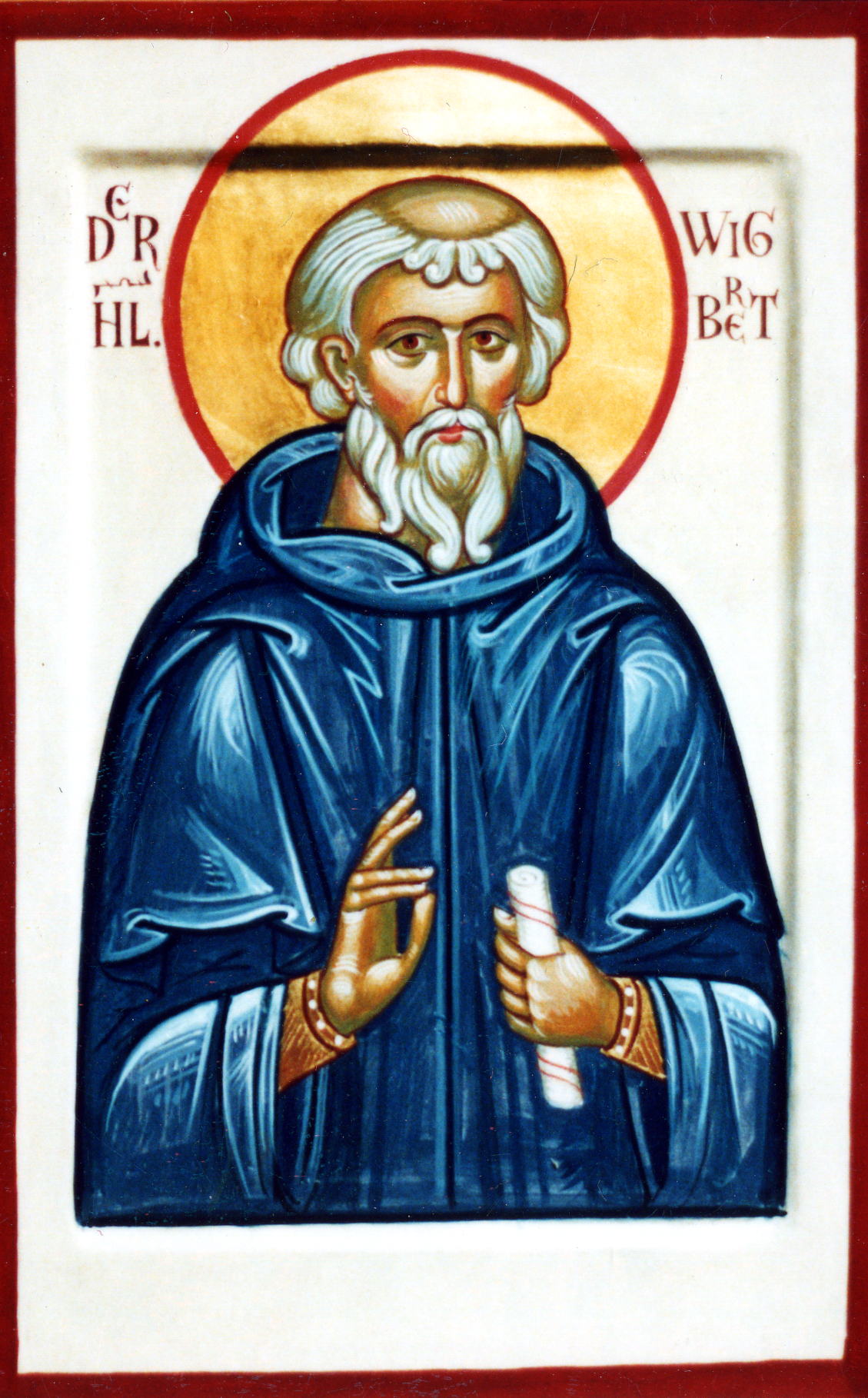
Saint Wigbert, Abbot of Fritzlar, Germany(† 797)
St. Wigbert was a priest and companion of St. Boniface (Winfred), apostle to Germany.
He became abbot at Fritzlar (Tritzlar) in Germany.
St. Wigbert was born in England about 675. He was known for the purity of his morals, his zeal for the salvation of souls, his boundless love, his penetrating knowledge and familiarity with the Scriptures.
He had great skill in teaching, struggled excellently in monastic podvig, and was faithful in all matters. St. Boniface summoned him from England to Germany, so in about the year 734 St. Wigbert went to Germany, and there he was made abbot of the monastery of Hersfeld in Hesse. Among his pupils was St. Sturmi, first abbot of Fulda.
About 737 Boniface transferred him to Thuringia as abbot of Ohrdruf, where he worked with the same success as in Hersfeld. Later, Wigbert obtained Boniface’s permission to return to Hersfeld to spend his remaining days in stillness and to prepare for the hour of death.
Even in old age and in illness he continued his austere mode of life, until the very end. The Saint reposed at Hersfeld in about 746.He was first buried at Fritzlar in an inconspicuous grave, but during an incursion of Saxons (774) his remains were taken for safety to Buraburg, and from there, in 780, his sacred relics were transferred by Abp. St. Lullus to Hersfeld.
In the year 850 a beautiful church was built to him, but it burned down in 1037. A new church was built and dedicated in 1144 but it burned in 1761 in a great fire, after which his sacred relics were never found again by men.
Holy Venerable Father Wigbert, pray to God for us!
Feast: Aug. 13
Saint Severinus, Apostle of Austria(† 482)
St. Severinus came to the borderland of present-day Germany and Austria from the east — possibly the Egyptian desert — to care for the Roman Christians who were endangered by invading barbarians during the collapse of the Roman Empire.
He remained there until the end of his life. While he was there he advised both common people and kings to put eternal life first, and taught them to be generous to one another and to lead a true Christian life.
He built a monastery and protected from harm those who gathered around him. As he foretold, the monks and other Christians who had followed him escaped to saftety in Italy, taking St. Severinus’ incorrupt relics with them.
His relics are still honored in Frattamaggiore, Italy (near Naples).
 —from the 2006 Saint Herman Calendar
Saint Ansgar (Anskar, Anschar, Anscharius, Scharies) of Germany and Evangelist of Scandinavian lands († 865)
Born near Amiens, Picardy, France in 801, died in Bremen, Germany on February 3, 865.
With the coming of the barbarians after the death of Charlemagne, darkness fell upon Europe. From the forests and the fjords of the north, defying storm and danger, came a horde of pirate invaders, prowling round the undefended coasts, sweeping up the broad estuaries, and spreading havoc and fear. No town, however fair, no church, however sacred, and no community, however strong, was immune from their fury. Like a river of death the Vikings poured across Europe.
It’s hard to believe that there would be an outbreak of missionary activity at such a time, but in Europe’s darkest hour there were those who never faltered, and who set out to convert the pagan invader. St.Ansgar was such a man. As a young boy of a noble family he was received at Corbie monastery in Picardy and educated under Saint Abelard and Paschasius Radbert. Once professed, he was transferred to New Corbie at Westphalia. He once said to a friend, ” One miracle I would, if worthy, ask the Lord to grant me, and that is, that by his grace, he would make me a good man.”
In France a call was made for a priest to go as a missionary to the Danes, and Ansgar, a young monk, volunteered. His friends tried to dissuade him, so dangerous was the mission. Nevertheless, when King Harold, who had become a Christian during his exile, returned to Denmark, Ansgar and another monk accompanied him. Equipped with tents and books, these two monks set out in 826 and founded a school in Denmark. Here Ansgar’s companion died, and Ansgar was obliged to move on to Sweden alone when his success in missionary work led King Bjørn to invite him to Sweden.
On the way his boat was attacked by pirates and he lost all his possessions, arriving destitute at a small Swedish village. After this unpromising start, he succeeded forming the nucleus of a church — the first Christian church in Sweden — and penetrated inland, confronting the heathen in their strongholds and converting the pagan chiefs.
Ansgar became the first archbishop of Hamburg, Germany and abbot of New Corbie in Westphalia c. 831. The Pope Gregory IV appointed him legate to the Scandinavian countries and confides the Scandinavian souls to his care. He evangelized there for the next 14 years, building churches in Norway, Denmark and northern Germany.
He saw his accomplishments obliterated when pagan Vikings invaded in 845, overran Scandinavia, and destroyed Hamburg. Thereafter the natives reverted to paganism. Ansgar was then appointed archbishop of Bremen around 848, but he was unable to establish himself there for a time and Pope Nicholas 1 united that See with Hamburg. Nicholas also gave him jurisdiction over Denmark, Norway, and Sweden.
Ansgar returned to Denmark and Sweden in 854 to resume spreading the Gospel. When he returned to Denmark he saw the church and school he had built there, destroyed before his eyes by an invading army.
His heart almost broke as he saw his work reduced to ashes” The Lord gave,” he said, “and the Lord have taken away. Blessed be the name of the Lord.” With a handful of followers he wandered through his ruined diocese, but it was a grim and weary time. “Be assured my dear brother, ” said the primate of France, who had commissioned him to this task, “that what we have striven to accomplish for the glory of Christ will yet, by God’s help, bring forth fruit.”
Heartened by these words, and with unfailing courage, Ansgar pursued his Swedish mission. Though he had but four churches left and could find no one willing to go in his place, he established new outposts and consolidated his work.
King Olaf had cast a die to decide whether to allow entrance of Christians, an action that Ansgar mourned as callous and unbefitting. He was encouraged, however, by a council of chiefs at which an aged man spoke in his defense. “Those who bring to us this new faith,” he said” by their voyage here have been exposed to many dangers. We see our own deities failing us. Why reject a religion thus brought to our very doors? Why not permit the servants of God to remain among us? Listen to my council and reject not what is plainly for our advantage.”
As a result, Ansgar was free to preach the Christian faith, and though he met with many setbacks, he continued his work until he died at the age of 64 and was buried at Bremen. He was a great missionary, an indefatigable, outstanding preacher, renowned for his austerity, holiness of life, and charity to the poor. He built schools and was a great liberator of slaves captured by the Vikings. He converted King Erik of Jutland and was called the “Apostle of the North”, yet Sweden reverted completely to paganism shortly after Ansgar’s death.
Ansgar often wore a hair shirt, lived on bread and water when his health permitted it, and added short personal prayers to each Psalm in his Psalter, thus contributing to a form of devotion that soon became widespread.
Miracles were said to have been worked by him. After Ansgar’s death, the work he had begun came to a stop and the area reverted to paganism. Christianity did not begin to make headway in Scandinavia until two centuries later with the work of Saint Sigfried and others. A life story was written about Ansgar by his fellow missionary in Scandinavia, Saint Rembert (Attwater, Attwater2, Benedictines, Bentley, Coulson, Delaney, Encyclopedia, Fanner, Gill, Robinson, White)
In art Ansgar is shown with converted Danes with him (White), wearing a fur pelisse (Roeder). He may sometimes be shown otherwise in a boat with King Harold and companions or in a cape and miter Hamburg Cathedral (Roeder).
Saint Ansgar is the patron of Denmark, Germany and Iceland (White). He is venerated in Old Corbie (Picardy) and New Corbie (Saxony) as well as in Scandinavia (Roeder).
Sourse ‘Orthodox Outlet for Dogmatic Enquiries’

Saint Remigius, Bishop of Rheims, Apostle to the Franks († 533)

Saint Remigius was born in 438 in northern Gaul. After devoting himself for awhile to secular and sacred learning, he withdrew to a small house near Laon, to live in reclusion and prayer. But when a bishop was needed in Rheims, the clergy and people carried him off from his hermitage and made him their bishop. He was only twenty-two years old at the time. The holy bishop soon became renowned throughout northern Gaul. He converted heretics, brought Arian heretics back to the Orthodox Faith, cared for the many who suffered at the hands of barbarian marauders. Wherever he went, miracles attended him. He healed the sick and demonized and once, when a town was on fire, threw himself into the flames and quenched them. Birds would come to his table whenever he ate, and he would share his meal with them. In 482 the young warrior Clovis became leader of the Frankish tribes in that region. Though he was a pagan, he knew and admired St Remigius, and was married to a Christian, St Clotilde (June 3). Once, when his army faced defeat by the Alemanii, Clovis prayed to 'the God of Clotilde and Remigius' and won a great victory. This answer to his prayers convinced him of the truth of the Christian Faith, and he asked St Remigius to instruct him. Two years later he gathered all his chieftains in Rheims to attend his baptism. The baptism was accompanied by many miracles, seen by all in attendance. Two of the king's sisters and three thousand of his lords and soldiers were baptized at the ceremony. This event is considered the birth of France as a Christian nation. In great old age, St Remigius went blind, but miraculously recovered his sight. He reposed in peace at the age of 105, immediately after serving the Divine Liturgy.

Saint Hilary, Bishop of Poitiers, France († 367)

The holy Hierarch Hilary was born of pagan parents in Gaul, and was trained in philosophy and rhetoric. At a time when paganism was still strong in Gaul, Saint Hilary understood the falsehood of polytheism, and became a Christian, and a great defender of his new Faith. About the year 350 he was ordained Bishop of Poitiers, when Arles and Milan were in the hands of the Arians and the Arian Constantius was sole Emperor. Like his contemporary Saint Athanasius, Saint Hilary's episcopate was one long struggle against the Arians. As Bishop of Poitiers, Saint Hilary foresaw the future greatness of Martin (see Nov. 12), and attached him to himself. In 355, when required to agree to the condemnation of Saint Athanasius passed by the Council of Milan, Hilary wrote and epistle to Constantius convicting the wrongs done by the Arians and requesting, among other things, the restoration of the Orthodox bishops, including Athanasius. For this, Hilary was banished to Asia Minor, where he wrote his greatest work, On the Trinity. Saint Hilary returned to his See in 360, where Saint Martin sought him out again. It was at this time that Saint Hilary blessed Martin to found a monastery near Poitiers, where Martin remained until being consecrated Bishop of Tours in 371. In his last years, Saint Hilary strove for the deposition of Auxentius, the Arian Bishop of Milan, but by affecting an Orthodox confession Auxentius retained his See. Saint Hilary reposed in peace about the year 368. Auxentius died in 374 and was succeeded by Saint Ambrose, who continued Saint Hilary's battle against Arianism. (Great Horologion)

Saint Denis (Dionysius), first Bishop of Paris, France († ca. 258)

Saint Denis (a westernization of the the Greek Dionysius), was one of seven bishops sent to Gaul by the Bishop of Rome during the reign of the Emperor Deccius. Their mission was to extend the spread of the Gospel in that mostly-pagan land. While most of the bishops were sent to major settlements, St Denis was assigned to the small, remote pagan town of Lutetia — which later grew to become the city of Paris. He and his companions settled outside the town in a house given to him by a convert, where the few Christians could meet in secret. Soon, through the holy bishop's grace-filled preaching and his many miracles, Christianity grew rapidly. Soon a fierce persecution of Christians swept through Gaul, and many of the faithful were abused, tortured or put to death. Saint Denis, fearless of danger and heedless of his own old age, travelled among the Christians, visiting the prisoners and exhorting all to remain firm in their confession of Christ. Soon he himself was arrested along with several companions, and was tortured without pity. When was publicly hung on a cross, he preached to the onlookers of the mystery of Christ's Passion. Taken back to prison, he celebrated the holy Eucharist for the last time, enveloped in a heavenly light. He and a host of other Martyrs were then beheaded on a hill, now called Montmartre in their memory. There is a tradition that at his beheading he rose up, took his own head in his hands, and walked for several miles to a place that later became the Basilica of St Denis in the town named after him. Before the French Revolution, the Kings and Queens of France were buried in this church.

Saint Eligius (Eloi), Bishop of Noyon (†660)

Saint Eloi was born to a Christian family near Limoges in Gaul (modern-day France) in 588. He became a goldsmith, worked for the royal mint, and in time became a trusted counselor of King Chlothar II. Despite (or because of) the honors and riches that surrounded him, Eligius came to despise all of them and gave away all his property but what he considered essential for everyday life. He devoted all his income to almsgiving and to ransoming prisoners of all nationalities from the slave markets. Many of these became his attendants and disciples in gratitude. Eligius' compassion became so well-known that when visitors asked for directions to his house, they would be told 'Look for the house surrounded by a crowd of beggars. That is where Lord Eligius lives.' The Saint washed the feet of the poor who came to him, served them at his own table and fed himself on what they left. If he ran out of money, he would give away furniture or even his clothing. When King Chlothar died in 629, Eligius became the counselor of his successor King Dagobert I. He founded monasteries for men at Solignac and for women in Paris, telling the King: 'These are the ladders by which we will both be able to climb up to the Kingdom of Heaven.' As a royal counselor he helped to re-establish peace between France and Brittany, and improved the law of the kingdom to make it more just. When Dagobert died in 639, Eligius devoted himself entirely to the service of God as Bishop of Noyon in Flanders. His diocese was still mostly pagan, and Eligius traveled untiringly to preach the Gospel of Christ, often at risk of his life. Having foreseen his approaching death, Saint Eligius reposed in peace in 660. When his tomb was opened a year later, his body was found incorrupt and gave forth a fragrant scent.

Κυριακή 7 Οκτωβρίου 2012

Saint Cassien, Bishop of Autun, France († 600)


A sincere attempt is being made with this new series by our website, to now acquaint our readers with the lives of the Orthodox Saints and Martyrs of the original One, Holy, Catholic and Apostolic Church of our Lord, who, like some of the Orthodox Saints of the British Isles, lived and propagated the Faith in the Western territories of the European Continent during the first millennium of Christianity and prior to the Great Schism of 1054 AD.

The Synaxarion calls him "Our Father Cassian, chosen by God to bring the illumination of Eastern monasticism to the West".

He was born in Scythia of noble parents, and was well educated in secular things. But, thirsting for perfection, he left all behind and travelled with his friend Germanus to the Holy Land, where he became a monk in Bethlehem.
After becoming established in the monastic life for several years, St John felt a desire for greater perfection, and sought out the Fathers of the Egyptian Desert. He spent seven years in the Desert, learning from such Fathers as Moses, Serapion, Theonas, Isaac and Paphnutius.

Through long struggles in his cell, St John developed from personal experience a divinely-inspired doctrine of spiritual combat. Many say that it was he who first listed the eight basic passions: gluttony, fornication, avarice, anger, sadness, acedia, vainglory and pride.

In time, struggles in the Alexandrian Church made life so difficult for the Egyptian monks that St John (still accompanied by his friend Germanus), sought refuge in Constantinople, where they came under the care and protection of St John Chrysostom. When the holy Archbishop was exiled, St John once again fled, this time to Rome, where he came under the protection of Pope Innocent I.

This proved to be providential for the Western Church, for it was St John who brought the treasures of Desert spirituality to the monasteries of the West.

He founded the monastery of St Victor in Marseilles, then, at the request of his bishop, wrote the Cenobitic Institutions, in which he adapted the austere practices of the Egyptian Fathers to the conditions of life in Gaul. He went on to write his famous Conferences, which became the main channel by which the wisdom of the desert East was passed to the monastics of the West.

Saint Benedict developed much of his Rule (which at one time governed most monasteries in the Latin world) from St John's Institutions,, and ordered that theConferences be read in all monasteries.

Saint John reposed in peace in 435, and has been venerated by the monks of the West as their Father and one of their wisest teachers. His relics are still venerated at the Abbey of St Victor in Marseilles.

St John's writings were soon attacked by extreme Augustinians and, as Augustinianism became the official doctrine of the Latin Church, his veneration fell out of favor in the West.

Outside the Orthodox Church, his commemoration is now limited to the diocese of Marseilles.

(Source:http://www.abbamoses.com/months/february.html

The "Western Rite": Is It Right for the Orthodox?

The vast majority of Orthodox Christians identify with a specifically Orthodox way of worshipping. Though different languages are used throughout the Orthodox world, Orthodox Christians who are traveling - or simply visiting a different "jurisdiction" in America - can count on the church architecture looking familiar, the outline of the Liturgy being the same and the means of approaching and receiving the sacrament of Communion being the same as they are used to. Or at least they could until recently. In America an increasing number of converts to Orthodoxy are using a liturgical ritual that looks far more like services done in Roman Catholicism and Anglicanism some thirty years ago. This is being enthusiastically promoted in some quarters of the Church as "western rite" Orthodoxy. The idea of using a "western rite" in the Orthodox Church first surfaced in England during the 19th century. A former Roman Catholic, Dr. Joseph Overbeck, joined the Orthodox Church in that country and apparently decided that Orthodoxy would never be able to evangelize the West unless it used western forms of worship. Otherwise, he reasoned, the Church would not have a "western memory." Overbeck suggested that a version of the Roman Mass - purified of any medieval errors - be used. His proposal, though received with interest in parts of the Orthodox Church, was never implemented. Earlier in this century, a small "western rite" group - the Eglise Catholique-Orthodoxe - began functioning in France. And still later, in the late 1950s, another small group (the Basilian Fathers) were received into the Antiochian Orthodox Archdiocese in the United States by then Metropolitan Anthony Bashir. These Basilian Fathers became the start of a canonical "western rite" presence in this country. Although the "western rite" of the Antiochian Archdiocese continued for years as a mere handful of par ishes, it has recently received a "shot in the arm" with the reception into Orthodoxy of a number of disaffected Episcopalians - sometimes including entire parishes. It is argued that the existence of a "western rite" within Orthodoxy offers these Anglo-C atholics a virtually perfect solution, since they can enter the Church without substantially changing their way of worship. After all, why should "unnecessary barriers" be placed in their way? Furthermore - so we are told - these "western rite" communiti es represent a return to the Orthodox Church of the authentic, pre-schismatic Orthodox worship of the ancient Christian west and therefore enhances her catholicity and appeal to all people. Compelling as these arguments may seem, the presence of a "western rite" within Orthodoxy represents a change from the way things have been since the Western Schism of the 11th century (or at least since the Fourth Crusade). As such, this innovation needs to be examined very carefully. For the sake of brevity, we will confine ourselves here to "western rite" Orthodoxy as practiced in America and examine it with regards to four fundamental questions: 1.) Does the reconstituted "western rite" actually represent an authentic return to the pre-schismatic Orthodox worship of the ancient Christian west? 2.) If there were a mass return of western Christians to Orthodoxy (say, union with Rome or Canterbury), would this "western rite" provide a workable precedent? 3.) Does the Orthodox Church need a "western rite" in order to evangelize Americans? 4.) Does the "western rite" serve the internal needs of the Orthodox Church in this country today? Does the reconstituted "western rite" actually represent an authentic return to the pre-schismatic Orthodox worship of the ancient Christian west? The "western rite" as currently practiced in the Antiochian Archdiocese consists of two Eucharistic liturgies. As they are quite different from one another, let's consider them separately. First, the "Liturgy of St. Gregory": this liturgy gets its name because it supposedly represents the Roman rite as practiced in the time of St. Gregory the Great, the bishop of Rome from 590 to 604 AD. There is no question that St. Gregory the Great left his mark on the history of worship - not only in the west, but also in the east. (Indeed, it may be argued that the Orthodox Church already has a Liturgy of St. Gregory - namely, the Presanctified Liturgy where this saint is always commemorated in the dis missal.) If the situation of having two Liturgies of St. Gregory isn't confusing enough, the question remains whether or not the Liturgy of St. Gregory as currently practiced in the "western rite" parishes of the Antiochian Archdiocese deserves this title at all. In fact, what we are actually presented with is the Tridentine Latin Mass (i.e., the Missal of Pius the V, printed in 1570), translated from Latin into King James English, with - among other things - references to the "merits of the saints" left out and the epiklesis of the Liturgy of St. John Chrysostom stuck in. In this regard, there are a couple of things to keep in mind. First, the Tridentine Mass was the Liturgy of the Roman Church as revised at the Counter Reformation. Second, the Gregori an Sacramentary (which, so far as the MSS tradition is concerned, is primarily Frankish and not Roman in origin) had already been revised in the 11th century (near the time of the Western Schism). So the present "Liturgy of St. Gregory" as used in America n "western rite" parishes is at least two revisions away from the saint whose name it bears - and both revisions were made at times of severe crises of faith in the west. The inadequacies of this rite become obvious on close examination. The anaphora, for example - far from being a single unified prayer as one would expect - seems more like a loosely joined collection of prayers. Stranger yet, the first of these prayers b egins with the word "Therefore" (referring to what? Apparently, some transition has gone missing!). As if the disjointed nature of this anaphora weren't bad enough, tinkering with it by well meaning Orthodox has only made matters worse. According to the great Orthodox liturgical scholar and saint, Nicholas Cabasilas, the prayer in the Roman rite "Supplices te rogamus" ("Most humbly we implore Thee") is an "ascending epiklesis." Even so, the epiklesis from the Liturgy of St. John Chrysostom has been adde d, thereby giving this rite both an ascending and descending epiklesis, in which the celebrant asks for the consecration of the gifts to be completed after it has already happened! Furthermore, such improbable features as the "last Gospel" are retained. (This was the reading of the prologue to the Gospel of John at the end of the service, a practice that had begun as a private devotion of the celebrating clergy sometime curing the 11th or 12th centuries and which, by the 16th century, had become a prescri bed appendage to the Mass.) Second, the "Liturgy of St. Tikhon": However inappropriate the "Liturgy of St. Gregory" may seem for Orthodox worship, it can't hold a candle in this regard to the other "western rite" liturgy now in use, which has somehow gotten itself named after a 20th century Russian saint. St. Tikhon served as the head of the Russian Orthodox Church in North America before being elected Patriarch of Moscow in 1917. During his tenure in America, he apparently received a petition for the use of a "western rite" from a group of American Anglo-Catholic Episcopalians. St. Tikhon then forwarded their request to the Holy Synod in Moscow, which examined this proposal carefully and granted the possibility of a "western rite", provided far reaching changes in the Book of Commo n Prayer were made. The Holy Synod left the final decision to St. Tikhon, who - for whatever reason - never formally authorized the establishment of a "western rite" during his pastorate in America. It therefore seems farfetched in the extreme to name th is liturgy after St. Tikhon. He is not the "father" of this "western rite" in even remotely the same way that St. John Chrysostom or St. Basil the Great are the fathers of the Liturgies which bear their names. Furthermore, even if St. Tikhon had authoriz ed the use of a "western rite", every administrative decision made by a saint should not be considered infallible. What, then, is the "Liturgy of St. Tikhon"? First of all, it is not the Eucharistic rite of the Book of Common Prayer as ever approved by the Episcopal Church. Rather, it is based on a strange amalgam commonly known as the "Anglican Missal." This missal was developed by Anglo-Catholics to make up for deficiencies they perceived in the Book of Common Prayer . The Anglican Missal contains the anaphora and other prayers from the BCP, folded together with parts of the anaphora and other prayers from the Tridentine Mass translated from Latin into King James English. As now used in the "western rite" of the Antio chian Archdiocese, it contains still further additions and corrections made by the Orthodox. A more confusing liturgical hodgepodge could hardly be imagined! The "Liturgy of St. Tikhon" is the Reformation rite of Thomas Cranmer, with additions from the C ounter Reformation rite of the Council of Trent, with still further superficial tinkering in order to make it "more Orthodox." In defense of this rite, some Orthodox are saying that we should accept it because it contains "nothing heretical." Unfortunately, that itself is an Anglican argument. An Orthodox rite must do far more than avoid heresy - it must clearly proclaim and tea ch the Orthodox faith. In Communist Russia as in Ottoman Greece, the Orthodox Liturgy alone maintained the faith through long years of persecution. Bearing in mind that Cranmer was probably a Zwinglian who designed his rite to express "the real absence" of Christ in the Eucharist, it is easy to see that the "Liturgy of St. Tikhon" could never meet the basic criterion of being an Orthodox Liturgy. In summary, the "Liturgy of St. Tikhon" has no historical validity whatsoever. The "Liturgy of St. Gregory" can be traced back to that great saint only in a very attenuated way. The simple fact is, neither of these liturgies represents an authentic retur n to the pre-schismatic Orthodox worship of the ancient Christian west. Does the "western rite" provide a path for the eventual reunion of Christians? With the reception of "western rite" parishes into Orthodoxy, there were some who felt that the Uniate ideal had now found its proper home. Comparison of Western Rite Orthodox to Eastern Rite Catholics is, of course, inevitable. And, we should keep in mi nd that historically, Rome has often held up its Eastern Rite Catholics as a bridge to union with the Orthodox. How successful has that bridge been? The truth is, Uniatism has been a continuous obstacle to unity between Orthodoxy and Rome. And this recurring difficulty reared its head again only recently, with the breakdown of Communism in eastern Europe. We would be naive in the extreme to suppose t hat "western rite" Orthodoxy will have a more beneficial result. If they grow in numbers, the "western rite" Orthodox will increasingly appear to western Christians as a kind of pseudo-Orthodox whose purpose is not to evangelize but to proselytize. Some might still argue that the "western rite" would at least demonstrate to "western" Christians what Orthodoxy would expect liturgically if a reunion of Christians should occur. Yet this too is groundless. The simple fact is, those parishes using the " western rite" within the Antiochian Archdiocese are not following the "western rite" as now practiced by the overwhelming majority of "western" Christians. Indeed, one must ask why the Orthodox Church should have made herself into a safe haven for a tiny minority of western Christians who have rejected the reforms of the liturgical movement. Regarding the "Liturgy of St. Gregory" - it would be ludicrous for the Orthodox to tell the Roman Catholics that they should go back to doing the "last Gospel" at the end of their Liturgy. Or that revisions made by Vatican II to the Roman anaphora to make it read more like a single prayer were somehow misguided. The "Liturgy of St. Tikhon" would be even more indefensible in the case of Anglicans. Many of the recent revisions to the Book of Common Prayer (as with the Roman Missal ) have been based on sound liturgical scholarship - and many are clearly borrowings from the ancient Christian east! Furthermore, since both of these "western-rite" liturgies are being celebrated in "King James" English, are we telling the Christians of t he various western confessions that modern English is unacceptable as a liturgical language? This, in spite of the fact that modern English is now used in many translations of the Liturgy of St. John Chrysostom? In summary, a "western rite" Orthodoxy, at least as it is currently being practiced, seems fated to have an increasingly negative effect on our already troubled position in ecumenical relations. Does the Orthodox Church need a "western rite" in order to evangelize Americans? If we can picture Overbeck in 19th century England we might realize why he felt an Orthodoxy using a "western rite" was absolutely essential if the Church was to have a viable mission in the West. Overbeck would have only been able to experience the worsh ip of Orthodoxy as done among recent immigrants, using not English, but the languages of their mother countries. No wonder he might reach the conclusion that only an Orthodoxy with a different rite, that had a western memory, could ever again be the churc h of the venerable Bede. St. Bede, of course, was a great Anglo-Saxon historian who lived long before the Western Schism. As such, he is perfectly acceptable to us Orthodox today as a saint to be venerated. So are many of the other saints of northwestern Europe - such as Patrick , Aidan, Alban and others, who are now being included in the liturgical calendars of Orthodox Churches. It is obviously a great advantage for converts to be able to venerate saints of their own ethnic background - and it speaks to the catholicity of the C hurch. Clearly, Orthodoxy doesn't have to have a "western rite" to have a western memory. With this in mind, let us suppose Overbeck's experience of the Church had been quite different. Suppose he had attended the celebration of the Liturgy of St. John Chrysostom on the feast of the venerable Bede and there in the narthex was a beautiful icon of this saint for veneration by the faithful. Suppose, too that the Liturgy had been conducted entirely in English. What could he find missing to celebrate the fe ast of this great saint of the early Christian west? True, the Liturgy would not be served in exactly the same way as Bede himself would have done. (But then, neither - by a long shot - would the "western rite" liturgies of St. Tikhon or St. Gregory be t he same as done by the venerable Bede.) What matters most is that the Liturgy of St. John Chrysostom and the ancient, pre-schismatic liturgical life of the west were the same in all essentials. Without question, Byzantine worship has demonstrated its suitability for all people. It became the dominant liturgical expression for the Russians as truly as it had been for the Greeks. It also rooted itself deeply in the culture of those Orthodox "Lati ns", the Romanians. And in Alaska it expressed the religious aspirations of native cultures - Aleuts, Tlingets and others. The Liturgy of St. John Chrysostom is now being celebrated in Japanese, Korean and a half dozen tribal languages in Africa. Recent ly, it provided the scriptural worship sought after by the Evangelical Orthodox Church, who were, until recently, the Antiochian Evangelical Orthodox Mission. The use of the Byzantine liturgical tradition by the AEOM is one of the strongest arguments, aga inst the need of a "western rite" for purposes of evangelization in America. But doesn't the use of the "western rite" make it easier to bring people into the Church when they already have "their own" liturgical tradition? Perhaps, but the drawbacks are enormous. Shortly after her former Episcopal parish was received into the "we stern rite" of the Antiochian Archdiocese in Spokane, WA a woman commented, "We were kind of underdogs in the Episcopal Church by worshipping in the old way. Now we feel we're in step with our Church." Sadly, it can only be a matter of time before she di scovers that she is now far more out of step liturgically with her new Church than she ever was with the old. In summary, the use of the "western rite" as a tool for evangelism seems unnecessary at best and misleading at worst. Does the "western rite" serve the internal needs of the Orthodox Church in this country today? A knowledgeable Orthodox Christian, if asked about the Church's greatest need in western Europe and the Americas today, would probably respond with a single word: unity. In this regard, the Byzantine liturgical tradition has been of inestimable value in h olding the Church together. On the other hand, ethnicity has probably been the greatest force for disunity. Ethnic heritage, of course, does not have to be a divisive factor. One can be proud of one's heritage while celebrating the fact that one is part of a Church that is truly multiethnic (as opposed to "non-ethnic", as the alternative is sometimes wrongly presented.) How does the "western rite" fit into this need to bring the Church together as a truly multi-ethnic community, united by faith and worship? Unfortunately, the "western rite" can be viewed as a kind of "super-ethnicity" which is just the opposite of what t he Church needs today. Narrow as their ethnic view might have been, and as much as they may have insisted unwaveringly on the use of their own language, Orthodox Christians have always shown a willingness to use a common form of worship - until now. For all intents and purposes, the use of the "western rite" takes ethnicity one step further. Not only do these converts insist on using (an archaic) form of their own language, but they also insist on using an exclusive liturgical rite that is common to no o ne but themselves. Orthodox Christians who visit a "western rite" parish will find themselves in an alien environment. Not only will the structure of the worship in a "western rite" parish be unfamiliar, but the very method of receiving the sacrament of communion will be di fferent, so that even though technically in communion, visitors from established Orthodox traditions will be discouraged from receiving the holy mysteries. ("Western rite" visitors to other Orthodox parishes will be similarly discomfited.) Contrary to th e ancient practices of the Church, "Byzantine" clergy visiting "western rite" parishes are not allowed - in current Antiochian practice - to concelebrate (and would hardly know how to, even if permitted). Pan-Orthodox services like the vespers for the Sun day of Orthodoxy are now rendered complex if not downright confusing by the possible presence of "western rite" clergy. Pilgrimage is a vital part of the Orthodox tradition and the current situation is bound to affect "western rite" pilgrims to traditiona lly Orthodox countries like Greece or Russia. Instead of finding themselves "at home" in the liturgical traditions of these foreign lands, they will be strangers in their own Church, unable to fully benefit from experiencing the liturgical life served in those holy places that mark the heartlands of what is supposed to be their faith. Furthermore, it is doubtful that the majority of Orthodox faithful and clergy in these countries would accept "western rite" visitors as "their own." Instead, they will pro bably be looked upon with a certain amount of suspicion, as a kind of "sheep in wolves clothing." Perhaps the plight of "western rite" Orthodox Christians is best understood by looking at the actual structure of an Orthodox Church, where the western part of the building is called the narthex. Though they are canonically within the body of Christ, the Church, Orthodox Christians using the "western rite" are still, in a sense, "only in the narthex." They will not be fully integrated into the Church's life until they can come forward and fully participate in the Church's liturgical worship with their bro thers and sisters in Christ. There are some, of course, who will point out that there was considerable liturgical diversity in the early Church - and therefore, why is such diversity not possible and even desirable today? There was indeed considerable liturgical variation from one pl ace to another in ancient times. The reason for this was the simple fact that the average person never got more than 25 miles from his place of birth and communications from one place to another were slow and difficult. Under such circumstances, liturgic al diversity was a natural development and hardly a problem. Today, by contrast, we live in what has been called a "global village" where communications are instant and American families often move several times, from one state to another, while their chi ldren are growing up. Everything in our environment argues for greater uniformity in liturgical practice. For example: what are potential converts to do when they happen to see coverage of an Orthodox service on television, become intrigued, and then are completely confused when they discover that Orthodoxy in their area has an entirely different look? Or, on the other hand, what is a "western rite" Orthodox family to do when they move to another town where the only Orthodox parish is "Byzantine" and pos sibly ethnic? What will they do when they feel far more at home in a "continuing" Anglican parish that meets down the road? In summary, the "western rite" can only impede the progress of the Orthodox Church towards reaching a goal of unity within ethnic diversity. Furthermore, a multiplicity of rites is simply inappropriate in a highly mobile society linked by global communications. There is no reason to question the motives of those who support a "western rite" within Orthodoxy. They are apparently doing so for what they consider to be the very best of reasons. In fact, we might all agree on the ends - yet with all due respect, we simply cannot agree on the means. The "western rite" is inherently divisive. Even so, we must not allow it to divide the Church. At the same time, Orthodox who do not accept the "western rite" are not simply "impeding progress." Rather, they are trying to safeguard the Church from a policy that is neither in the best interests of her established members, nor of her converts. We rejoice whenever and wherever converts are received into the Church. But we also take heart from the fact that many "western rite" parishes eventually see the wisdom of "converting" to the Byzantine liturgical tradition. We can only hope that others will continue to follow that good example. Father Michael Johnson pastor, St Nicholas Church Tacoma, WA The Priest. A Newsletter for the Clergy of the Diocese of San Francisco. Is